The ETS should not be amended, but withdrawn entirely. It fails on every count and is in fact counter-productive.
The Government's discussion document admits that in its seven years, the ETS has not reduced NZ's climate pollution; in fact, emissions are expected to rise to 96 per cent above 1990 levels within 15 years.
Many suspect the design of the ETS, with no price floor and no emissions cap, was never intended to make a real difference to our climate-changing emissions. It was intended to provide a trading platform for speculators, which it has done.
Any further public time and expense tweaking a broken system will send good money after bad, and use resources that would be better used on measures that will actually reduce emissions.
Jeanette's conclusion.
The ETS should be abandoned and replaced with a simple and gradually rising price on carbon through a carbon charge, the proceeds distributed equally to all New Zealanders.
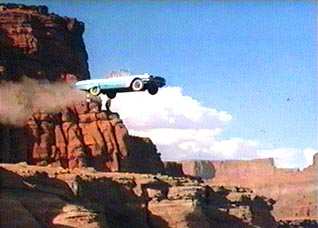
I look at at the Government's latest token consultation about tinkering with the train-wreck New Zealand Emissions Trading Scheme. We are still driving fast towards a cliff but the argument has moved from which gear to air-con versus heater. The Government has kindly given us the opportunity to make a submission about how hot or cold we should be as we go over the emissions cliff.
Back in September 2012, when Tim Groser and the National Government were last watering down the New Zealand Emissions Trading Scheme (NZETS), I wrote a post that used an excellent metaphor for amending the NZETS, tinkering with the gears while driving a car fast towards a cliff.
All credit should go to former Greens co-leader Jeanette Fitzsimons who had absolutely nailed her answer to questions from TVNZ about the relevance of amendments to the NZETS.
For all that has happened in the last three years, such as the Doha COP meeting, the Poland COP meeting, New Zealand opting out of a binding second Kyoto commitment, New Zealand being excluded from the international carbon markets, the 2020 target and 2030 target and the recent Paris Agreement, the fast-car-over-the-cliff metaphor still nails the state of the NZETS; that it is so far from being an effective emissions mitigation policy that 'reviews' are merely futile tinkering in the face of the impending threat of climate change. Especially when the scope of the review deliberately excludes the option of including agriculture in the NZETS.
The first stage of the review is a perfect example of futile tinkering. It is very narrowly focused on just two of the many 'cost-moderating' measures inserted in the NZETS in 2009 and extended in 2012.
Should we end the two tonnes-for-one unit deal, so that energy and industry emitters have to surrender one unit for every tonne of GHG emissions, rather than one unit for two tonne of emissions?
Should we adjust the existing $25 price cap or fixed price surrender option?
Richter makes several interesting observations (No really! The thesis is worth a read if you are a ETS wonk). In some ways the political influences on the NZETS design were typical of the international experience (page 60): "allocation is nearly always contentious, often free, and often heavily influenced by lobbying".
In other ways, the NZETS experience of these 'cost-moderating' features is unique to New Zealand. During the 2007 design stage, Treasury and the Ministry for the Environment assembled a complete smorgasbord of possible 'cost-moderating' features (free allocation, access to international markets, safety-valve price caps, two-for-one obligations). As these measures all had the same function (reducing cost and therefore price impacts), they felt only some were necessary in the 2008 NZETS. However, the 2009 amendments added all the cost-reducing measures into the NZETS. As Richter notes with understatement
"Additional moderating design features in the NZ ETS are also mentioned in literature and have been used in other schemes; however New Zealand is unique in the range of these features all incorporated into one ETS."
In other words, the National Government threw the whole kitchen sink of cost-moderating features into the NZETS. They said to New Zealand's big businesses "Forget your diets, just try and eat everything on the buffet".
The one-for-two surrender obligation allows participants from the liquid fossil fuels, industrial processes, stationary energy and waste sectors to surrender one unit for every two tonnes of emissions (ie, a 50 per cent surrender obligation). This means that these participants do not face a full obligation for their emissions. As a result, the effective carbon price they pay is half the unit price. For example, with a New Zealand Unit (NZU) price of $7, these emitters pay an effective carbon price of $3.50 for each tonne of emissions, with a maximum effective carbon price set at $12.50 due to the $25 fixed price surrender option (page 12).
What to do with the two-for-one deal. This is just a no-brainer. Of course, the two-for-one deal should just end! It was meant to end in 2012, and the 2012 extension was flagged at the time as being temporary and ending in 2015.
So why are we even consulting about this non-issue? Surely the policy default is that any well-designed transitional measure should simply end on the date specified in the original policy? Of course, from the point of view of political economy, such things as policy defaults and burdens of proof can be influenced by political interests.
We can view the Ministry for the Environment's decision to have a consultation over the end of a transitional measure (such as the two-for-one deal) as changing the burden of proof. Instead of the transitional measures (of which there are many in the NZETS) simply expiring, a process must be held to arrive at that decision. This involves policy assessment and consultation. The expected end-point of the two-for-one deal changes in character from that of an automatic expiry, to an open "yes/no" decision where the default is the status quo of indefinite extension.
And so the burden of proof now falls on the advocates of change (to a tighter ETS) and is removed from the advocates of the status quo who want an eternal transition.
The discussion document even expands the unnecessary scope of the decision by presenting three options (page 13); maintain the 2-for-1 deal indefinitely, or extend the term then review it, or scrap it and make emitters pay for each tonne of greenhouse gases. The document at least states the real world implication of keeping the 2-for-1 deal indefinitely: NZ unit prices would remain less than $NZ12.50 per unit, i.e. half of the price cap of $NZD25.
The discussion document describes the second issue about the $25 price cap/fixed price option as follows:
The $25 fixed price surrender option allows businesses to surrender an NZU by paying the Government $25 per unit. It was established as a transition measure in 2009 to protect firms and the economy from price spikes or excessive costs. It acts to cap the maximum carbon price in the NZ ETS, and in combination with the one-for-two surrender obligation, it currently ensures that the maximum effective carbon price any non-forestry participant will face is $12.50 per tonne (page 14).
Again it is a no-brainer that this price cap should be removed. It was always obvious that in the long-term it would cap NZ unit prices at $12.50 per tonne. However, to the best of my recollection, this is the first time the Ministry for the Environment has explicitly said so. The inclusion of the price cap in itself indicates a lack of real commitment to an emissions trading approach. If the Government was that concerned about upward volatility in emission unit prices, they should have implemented a carbon tax and not an emissions trading scheme.
Rather than discouraging me, writing this post has made me more determined to make a submission. Perhaps even two, as the trustees of carbon forest project I am involved in, also want to make a submission. Both submissions will probably use the expression "no brainer" several times.
Submissions on these two issues close at 5pm on 19 February 2016. Submissions can be made online, by emailing nzetsreview@mfe.govt.nz or writing to the Ministry for the Environment, PO Box 10362, Wellington 6143.
To end this post I give you this cultural mash-up by the under-rated American performance artist Vin Diesel which blends car crashes, train wrecks, cliffs and even a bit of Butch Cassidy and the Sundance Kid.
I look at at the Government's amendments to the New Zealand Emissions Trading Scheme and conclude we are arguing about what gear to drive in as we speed towards the cliff. The Government has kindly given us the opportunity to make a submission about how fast fast we should go over the emissions cliff. Time to fasten your seatbelts.
Consistent with previous emissions trading scheme legislation, the bill will be fully and rationally considered by Parliament's Finance and Expenditure Select Committee in an insultingly short period of time - ten working days. The closing date for public submissions is Monday, 10 September 2012.
* The 'two-for-one' deal, which halved the number of carbon credits each emitter had to surrender for a tonne of carbon dioxide equivalent greenhouse gases, is extended for another three years. It was to end on 31 December 2012, but will now run on at least to 2015.
* The price cap of $12.50 per tonne ($25 for two tonnes) will also extended. It was to end on 31 December 2012, but will now run on at least to 2015.
What doesn't the bill do?
* It ignores the recommendation from the 2011 ETS review committee to stop the unlimited use of international carbon credits by New Zealand emitters. Which as we know, makes the NZETS the weakest link.
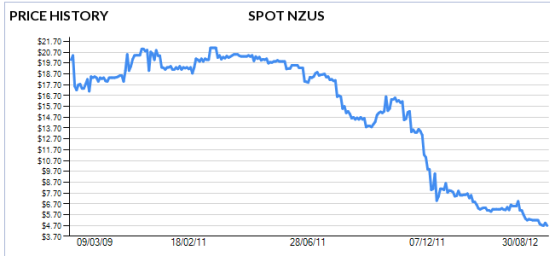
Whats the cliff we are driving off? Well, it's climate change. And it's the price of the New Zealand emissions unit.
Business New Zealand seem unusually silent. I guess for them it is all going to plan. Back in July they welcomed Tim Groser's announcement of the delays to the NZETS. So why waste space repeating the message?
However, I do offer some relief from this dreary "business-as-usualism".
Green MP Kennedy Graham has given some strong speeches accurately reflecting both the scientific reality of the cumulative carbon dioxide emissions and the ethical challenge of the failure of politics and governance to respond.
"Today's bill will defer agriculture indefinitely, defer any increase in the price cap, defer the one-for-one surrender obligation, allow a greater switch from forestry to dairying, and enable importers to increasingly use dangerous synthetic gases. What remarkable, steel-like resolve!"
Graham, a much more experienced diplomat than Tim Groser, walks us through more than 20 years worth of futile international climate change negotiations, all the while as the relentless accumulation of emissions in the atmosphere uses up the carbon budget consistent with limiting warming to two degrees. And with no faux-realist "get people on the bus" cliches we have come to expect from Tim Groser.
How about "the NZETS is completely ineffective in reducing GHG emissions due to it's many design flaws - the use of unlimited international junk credits, the delays and exemptions, the partial coverage, the lack of a cap, the price ceiling, the lack of revenue recycling due to the excessive free allocation to emitters."
"Look, its like we are in a very fast car, we are heading towards a cliff, which is getting really close, and we are arguing whether to change from fifth to fourth gear".