Showing posts with label emission units. Show all posts

06 June 2023

The unbearable annual updates to the NZ ETS auction volume limits and price control settings for units 2023

The Ministry for the Environment is running a consultation on the utterly incomprehensible Annual updates to the NZ ETS limits and price control settings for units 2023.

There is a very dense 56 page consultation paper Ministry for the Environment. 2023. Annual updates to New Zealand Emissions Trading Scheme limits and price control settings for units 2023: Consultation document. Wellington: Ministry for the Environment..

This is based on another annual round of dense advice over 64 pages from the Climate Change Commission Advice on NZ ETS unit limits and price control settings for 2024-2028

I wrote a submission today. Due to the density of the reports, and the way Ministry for the Environment framed the 24 compulsory questions, it was really hard. Submissions close on 16 June 2023.

I can however try to summarise it in three charts.

The Climate Change Commission wants the Government to reduce the number of emission units it auctions from 2026 to 2028.

The Climate Change Commission wants the Government to increase the minimum price for emission units in the auctions from 2026 to 2028.

The Climate Change Commission wants the Government to increase the cost containment reserve 'maximum price' for emission units in the auctions from 2026 to 2028.

I am guessing that a Chris Hipkins led Labour Government is probably going to try to ignore the Commission's recomendations.

Russell McVeagh have the best short summary of the issues: Climate Change Commission urges Government to reduce ETS unit supply and raise trigger prices.

27 May 2023

If it's worth paying New Zealand Steel to reduce emissions shouldn't we first stop paying them emission units to increase emissions?

The $140 million emissions subsidy to New Zealand Steel is not just corporate welfare, it's greenwashing and it's climate bright siding and it's our insane emissions trading scheme. Can we have our 16 million free emissions units back?

I am still blown away by the Government's announcement a week ago that they will pay New Zealand Steel Ltd $140 million over three years to adopt an electric arc furnace that reduces the emissions intensity of steel smelting.

I am also blown away by the over-egging of the project by the Chris Hipkins, Megan Woods and James Shaw.

Hipkins states:

“The economics of this really stack up, especially compared to current carbon prices. The lifetime abatement cost is forecast at $16.20 per tonne. Current carbon prices are around $55 per tonne. In the long term this saves the Government and the country money.

And I am also aghast at the largely uncritical treatment of the announcement in the media. Much comment fails to look at the NZ Steel deal in the context of our dreadful emissions trading scheme (or ETS). Some comment has included basic errors of fact such as saying New Zealand Steel is exempt from the ETS.

Massive emissions cutting deal says Luke Malpass in Stuff.

James Shaw is quoted by RNZ

"The lifetime abatement cost is forecast at $16.20 per tonne. Current carbon prices are around $55 per tonne. In the long term this saves the government and the country money."

Duncan Greive at The Spinoff calls it the beginning of a new climate pragmatism.

Duncan Greive makes this factual error.

"NZ Steel was already exempt from the Emissions Trading Scheme (ETS), having baldly stated that it would have shut the factory were it to have to pay the cost of its emissions"

No, New Zealand Steel is not exempt from the emissions trading scheme (They would be more likely to face a carbon price if they were exempt). Yes, they have threatened to close the smelter. Several times

Michael Neilson in the Herald says the initiative is remarkable.

Bernard Hickey agrees with Hipkins and says it's $140m well spent at $16.20/tonne.

Even the Lawyers for Climate Change Action, who have just filed a judicial review of the December 2022 ETS price settings decision, said "This is a great initiative"

What's the relevance of Hickey and Hipkins and Shaw comparing the predicted cost per tonne of emissions reduced with the current market price of emission units?

It's emission pricing. Carbon prices are emblematic of having an emissions trading scheme. And in theory New Zealand is big on emissions pricing.

The Ministry for the Environment keeps saying "the New Zealand Emissions Trading Scheme is the Government’s main tool for reducing greenhouse gas emissions". New Zealand has had an emissions trading scheme since 2010. It includes the steel industry.

This is the emissions pricing logic.

  • NZ Steel's emissions are covered by the ETS and are priced via the mandatory surrender of emission units.
  • NZ Steel has a project to reduce emissions that will cost less per tonne of emissions than the current market price.
  • NZ Steel's overall emissions liability under the ETS will reduce.
  • The project pays for itself as it is the lower cost option.

That's what emissions trading schemes are meant to do.

So why isn't NZ Steel paying 100% of the cost? Why is the Government paying almost half? Why are Hipkins, Wood and Shaw saying this subsidy isn't just necessary but it's good policy?

The answer is the bullshit that is the emissions trading scheme Industrial Allocation rules.

Tom Pullar-Strecker of Stuff, who seems the only skeptical voice, correctly notes New Zealand Steel would never fund the electric arc furnace as they receive so many free emission units under the ETS Industrial Allocation rules.

Pullar-Strecker has also noted that in New Zealand Steel's last annual report, it received free emission units worth $117 million. And that the chief executive stated they received so many free emission units that carbon costs were "neutralised" including indirect ETS costs from electricity prices.

Just to repeat the point again. New Zealand Steel are allocated far more free emission units than needed for their actual smelter emissions.

They have never needed to buy any additional units to comply with the ETS.

Here is the chart of actual final allocations of emission units from the EPA to NZ Steel compared to the estimated actual steel emissions from the Greenhouse Gas Inventory.

What's that mean? Buying emission units and surrendering them back to the Government annually is the essence of an emissions price.

Receiving free emission units and surrendering some of them back to the Government and keeping some each year (you are always a net seller) is the opposite of an emissions price.

Receiving free emission units is in fact payment of a subsidy for New Zealand Steel's emissions.

If New Zealand Steel increases it's emissions they receive more units

If New Zealand Steel reduces it's emissions they would receive fewer units

So if New Zealand Steel installed the electric arc furnace, and reduced emissions from its Glenbrook mill by 800,000 tonnes, they would be financially worse off as they would lose more than 800,000 emission units.

That is how insane the emissions trading scheme is.

This chart shows the $308 million value of the unit allocation subsidy to NZ Steel from 2010 to 2021 and highlighted is the Government's electric arc furnace grant of $140 million over three years 2022 to 2024.

Our emissions pricing scheme is so flawed it incentivises maintaining and increasing emissions. It is 180 degrees in the wrong direction. This is emissions trading insanity.

If it's worth paying New Zealand Steel to reduce emissions shouldn't we first stop paying them to increase emissions?

17 March 2023

Explaining the emissions budget it's the bodge that gives the number of emissions units to auction

I feel I need to do a deep dive into emissions budgets.

The emissions budget is the bodge that papers over all the cracks and flaws in the emissions trading scheme. It calculates the number emissions units to auction into the New Zealand carbon market.

Emissions budgets are part of the huge blob that is New Zealand's climate policy framework, along with:

Specifically emissions budgets are a relatively new tool (added in the 2020 reforms) to calculate the amount of emissions units that will be auctioned to emitters under the New Zealand Emissions Trading Scheme. The first auction of emission units was in March 2021.

The Ministry for the Environment's web site has an explanation of how the emissions budgets help calculate the amount of units to auction into the emissions trading scheme each quarter.

The web page features this chart showing the working parts of the emissions budget.

The web page then shows this table of the annual auction volumes.

However, the table and the chart don't match. They cover different five year periods. There is also an error in the html code of the table. There is a blank cell missing in the first row and first column. And the column headings need to be moved one cell to the right so that 'TOTAL' is above '75.2'.

I emailed the Ministry back in mid February to let them know. However, nothing has changed.

I find that quite comical. The web site administrator and the external relations person just got so bored talking with the emission policy person that they fell to sleep. If it's comedy, it's really a tragedy-comedy. One day far in the future, alien anthropologists will discover that the planet Earth missed it's global warming goals because they were too "My Eyes Glaze Over" for any one to understand.

Specifically, the emissions budget is the 2020 provisional emissions budget for the years 2021 to 2025. This comes from a Q and A document attached to a Government media release dated 2 June 2020 Emission trading reforms another step to meeting climate targets by James Shaw Minister for Climate Change Issues.

These five year emissions budgets roll forward as each year passes. So the current emissions budget is 2023 to 2027.

What is the point of the five year emissions budget?

It is to drag down the trend line in New Zealand's gross and net emissions of greenhouse gases. This is helpfully shown by this chart from the Climate Change Commission's advice to the Government. We can see the three jaffa and blue coloured bars representing the three five year budgets 1 , 2 and 3 sequentially reducing and pulling down the trend line of emissions.

This next chart, 'Figure 7' from the Ministry for the Environment presents what looks like an area chart (Except its actually a barplot of five time intervals). Look at the area underneath the black dashed line of net emissions and the solid red line of a trajectory towards the 2030 emissions target. A wedge shaped area of 'additional reductions' is needed to drag the forecast line down to the trajectory to the target. The area under the trajectory (to the target) is 354 million tonnes of net emissions. So the decreases in emissions are squeezed to the later years.

Here is my version of the same bar chart of five years of emissions. It uses the same area 354 million tonnes of net emissions (derived from the 2030 target) and the same colours.

The next step is to add the target trajectory red line and the annual amounts of net emissions from 72 million tonnes in 2022 to 68 million tonnes in 2025.

So, okay, we have an emissions trading scheme. Those 354 million tonnes of greenhouse gases will be represented by 354 million emission units that could be auctioned to emitters. As basic economics says that will be the most efficient way of allocating the emissions to buyers.

Ha ha ha! Of course that's not what is done! Instead we have to do a 'bodge' and subtract millions of tonnes from the emissions budget to deal with the fundamental flaws in the emissions trading scheme.

This is the crux of the problem. However, neither James Shaw or the Ministry for the Environment discuss this 'budgetting' as the crude bodge that it is.

The emissions of pastoral agriculture are not yet subject either to a methane-based emissions levy or to the emissions trading scheme. And perhaps may never be subject to emissions pricing if Beef and Lamb NZ's latest anti-regulation campaign succeeds.

So the first step is a 'bodge' to subtract the emissions of agriculture. This is 194 million tonnes, more than half the emissions budget of 354 million tonnes.

So are the remaining 160 million tonnes going to be auctioned? No, there's another subtraction. Under the emissions trading scheme industrial allocation rules, emissions-intensive industries are given free emissions units...which they then surrender back to the Government.

So those emissions are not priced. Free allocation of units has the same effect as the exemption of agriculture, the units have to be subtracted from the emissions budget as you can't auction units that have already been given for free to emitters. The numbers are 8.6 million units per year or 43 million for 2021 to 2025.

Is that it? No, there's another bodge. There are too many emission units in private hands. There were 164,329,773 emission units at 31 December 2022. This surplus is called the stockpile. These units could be sold into the market at any time. Which would allow more emissions. Thus emissions would exceed the emissions budgets. The Climate Change Commissions and the Government would like to reduce the stockpile. So another 27 million tonnes are subtracted.

Now my chart of the 2020 provisional emissions budget is almost the same as the Ministry of the Environment's chart. That final bodge leaves a budget of 90 million tonnes left to auction into the carbon market. Or 18 million per year. Or 4.75 million emissions units to be auctioned from the first quarterly auction of emission units held on 17 March 2021.

This chart displays the same unit numbers and shows the sum of the bodges, how 264 million tonnes out of 354 million tonnes are not priced through the emissions budget process.

This chart has the same axes as the previous chart but just shows the number of units to be auctioned. Only 90 out of 354 million tonnes of emissions are priced via the auctions.

This chart now summarises the message of the two previous charts. Because the design flaws in the emissions trading scheme require bodges (by subtraction) to the emissions budget, only a quarter (25%) of the 2021 to 2025 emissions budget is expected to be priced via auction sales to emitters.

Summary points to note. The emissions trading scheme has fundamental flaws in it's design:

  1. the exclusion of agricultural emissions from ETS obligation,
  2. the excessively generous industrial allocation of free emissions units to emitters,
  3. the excessive surplus of privately held emission units reflecting the importing of 'hot air' international units.

These three flaws require bodges to the emissions budgetting process that reduce the quantity of emissions subject to an emissions price via auctions.

04 March 2023

End the industry allocation subsidized free emission units given to polluting industry to fund Cyclone Gabrielle recovery

Every year since 2010, emissions intensive emitters have received a subsidy of millions of free emissions units under the emissions trading scheme 'industrial allocation' rules.

Is it still morally conscionable for the emissions trading scheme to keep giving emitters millions of dollars worth of free emissions units, when the costs of recovery from the climate tragedy Cyclone Gabrielle are going to be billions of dollars?

I penned this message to Prime Minister Chris Hipkins, Finance Minister Grant Robertson and Minister for Climate Change James Shaw.

"Tena koe Prime Minister Hipkins,
The Dominion Post has reporting that the Minister of Finance the Hon Grant Robertson has said that billions of dollars will be needed for the recovery from Cyclone Gabrielle. I don't think anyone reasonable is disagreeing with him about the scale of the challenge helping impacted communities.
I have a suggestion to help provide funds for Cyclone Gabrielle without either raising new taxes or new borrowing or by reducing funding of important existing programs.
The Ministry for the Environment and the Climate Change Commission both expect that in calendar year 2023, 6.4 million emissions units will be allocated at no cost to industries.
At Tuesday's spot price of $67.50, these units would be valued at $432 million. My suggestion is to quickly amend the Climate Change Response Act 2002 (or it's related regulations) and add the industrial allocation units to the quarterly auctions of emission units and commit the proceeds to recovery from Cyclone Gabrielle.
You will need to get officials to act promptly as emitters will be applying for units from January to April 2023.
As the amount of forecast allocation units is over 6 million units through to 2027, there is an ongoing stream of about 400 to 500 million dollars (depending on unit prices) available for another 5 years.
What could be a better source of funding for recovery from a climate crisis event than diverting funding from emitter industries?"

The Climate Change Commission's estimate of the free emission units allocated is from page 38 of their report "Advice on NZ ETS unit limits and price control settings for 2023-2027".

Let's make a bar plot of the free emission units.

The Ministry for the Environment says that the spot market NZU price has followed the cost containment reserve trigger price (page 25 of Proposed changes to New Zealand Emissions Trading Scheme limit and price control settings for units 2022: Consultation document);

Since the NZ ETS closed to international markets in 2015, the market price of NZUs has closely tracked the upper limit price controls, the $25 and then $35 fixed price option, and the more recent $50 and then $70 cost containment reserve trigger price.

What is the cost containment reserve trigger price? The Climate Change Commission (Op cit) says: "The cost containment reserve (CCR) is a reserve of NZUs available for sale if the auction clearing price is at or above a specified trigger price".

The cost containment reserve trigger price is set in Schedule 3 of the Climate Change (Auctions, Limits, and Price Controls for Units) Regulations 2020.

The reserve trigger prices are also listed on the Ministry for the Environment's website Price control settings.

Clearly we need a bar plot of the cost containment reserve trigger prices.

Assuming that from now until 2027 the spot price for NZUs follows the cost containment reserve trigger price as it did in 2022, then the market values of the 'industrial allocation' free emission units are the volumes (about 6 million units per annum) multiplied by the trigger prices.

Which results in about half a billion $NZD per year for recovery from Cyclone Gabrielle.

2023 $516,096,000
2024 $577,143,000
2025 $650,412,000
2026 $718,208,000
2027 $792,817,000

By 2027 this will add up to a total fund of over $3 billion $NZD ($3,254,676,000).

We need to make another bar plot.

While I have received automated email replies to my emails to Hipkins, Robertson and Shaw, I have not received a substantative reply.

It just seems a no brainer to me that it is morally unconscionable to have an emissions trading scheme that subsidizes emissions intensive industry with $3 billion worth of free emissions units when those funds could be put into recovery from Cyclone Gabrielle.

15 December 2022

Industrial allocation exempts from pricing twice as many tonnes of emissions than the actual total for the Industry sector

I reach back in time to 2009 when the Hon Dr Nick Smith was the Minister for Climate Changes Issues and his introduction to the emissions trading scheme of the supermarket special the "two for one" deal.

I left the previous post on Industrial Allocation noting that in the 11 years from 2010 to 2020 there were 162 entities that were given, at no cost, 55 million emission units as they are deemed to be "emissions-intensive and trade-exposed".

In the same period the total actual emissions recorded in the Greenhouse Gas Inventory for all industries was 53 million tonnes of carbon dioxide equivalent.

My data analysis is at this Git hub page Industrial Allocation.

Here is a barplot of the allocation (gifting, giving for free, donating) of the 55 million emission units to selected emitter industries.

Here is a barplot of the 53 million tonnes of actual emissions from the New Zealand industrial sector from the Greenhouse Gas Inventory.

Here is a line chart of the 53 million tonnes of actual emissions and the Industrial Allocation - the free allocation of the 55 million emission units.

So at first glance it appears that the amount of free emission units allocated cancel out the actual industry emissions. This suggests that in a net sense the industry sector emissions are not priced at all under the emissions trading scheme They are more than 'offset' by the allocation of free units. So it's the same net result as if the industry sector was completely exempted from the emissions trading scheme requirements to surrender emission units equal to their emissions.

However I am missing a step in my analysis. In my detailed examples for New Zealand Steel and New Zealand Aluminium Smelters, I estimated the actual liability to surrender units by multiplying the Greenhouse Gas Inventory steel and aluminium emissions by a variable representing the "two for one" discount introduced in 2009 by the Hon Dr Nick Smith when he was the Minister for Climate Changes Issues.

On 1 September 2009 with Dr Smith's approval "Emissions trading bulletin No 11: Summary of the proposed changes to the NZ ETS" was published. It stated that the emissions trading scheme would be amended by adding a transition phase lasting to 31 December 2012 which would feature a "progressive obligation".

A transition phase will operate until December 2012. The transition phase will be implemented through....a progressive obligation requiring SEIP and LFF participants to surrender only one unit for every two tonnes of CO2-e emitted

The 'progressive obligation' was effectively a 50% discount on the 'surrender obligation', the quantity of emissions units that emitters had to surrender. Each firms industrial allocation of emission units would in consequence also be halved as well.

Then in 2012, Minister for Climate Change Issues Tim Groser introduced the Climate Change Response (Emissions Trading and Other Matters) Amendment Bill. This bill extended the life of the "two for one" 'progressive obligation' indefinitely.

Finally, in 2016, Minister for Climate Change Issues Paula Bennett introduced a bill to "phase out" the 'progressive obligation' over three years from 2017 to 2019 by increments from the original "two for one" - 2 units per tonne to 1.5 to 1.2 to 1 unit per tonne of emissions. See the "EPA document ETS Surrender Obligations One for two phase out factsheet"

So I need to include a discount variable that is applied to the free emission units allocated to result in the "emissions footprint" of the allocation of units. The discount variable is 0.25 for 2010 (half obligation for half a year),then 0.5 from 2011 to 2016, 0.67 in 2017 ,0.83 in 2018 and finally one for one for 2019 and 2020.

This allows me to estimate of the carbon footprint or emissions footprint of all the units given under Industrial Allocation. As in this chart.

I can then add the 'emissions footprint' values or the emissions allowed by the free Industrial Allocation units to the chart of allocated emission units and actual industry emissions.

The chart shows a huge gap between the emissions footprint and the allocated units until 2017 when the two lines start to converge.

Then in 2019, the emissions foot print is the same as the units allocated as finally, under the emissions trading scheme, one emission unit does in fact equate to one tonne of emissions.

The total of the Industrial Allocation 'emissions footprint' over 2010 to 2020 is 89 million tonnes. Meaning that those 89 million tonnes have been "de-priced" by the emissions trading scheme.

Just a reminder. What is an emission unit? It's a right to emit greenhouse gases to the atmosphere.

Owning an emission unit is the same as permission to emit a quantity of greenhouse gases whether from smelting or just from burning coal oil or gas.

Being allocated a unit is the same as being told "go for it - you can just burn coal or oil or gas without penalty until a tonne of carbon dioxide is in the atmosphere".

It's the opposite of a price on carbon. It's a permit or licence to burn carbon.

The emissions footprint of Industrial Allocation, from 2010 to 2020, at 89 million tonnes, is twice as much as the actual emissions of the whole industry sector for the same period.

How can that possibly be the case? It is because of the energy allocation factor.

Industrial Allocation "de-prices" and removes the emissions price signal from some energy sector emissions in addition to the direct industry process emissions.

In a net sense Industrial Allocation is worse as a policy to reduce industry emissions than a complete exemption of industry from the emissions trading scheme. In a scenario of 100% exemption, at least all energy sector carbon emissions would in theory be priced.

Hence my headline conclusion Industrial allocation exempts from pricing twice as many tonnes of emissions than the actual total emissions for the industry sector.

22 November 2022

Emissions trading scheme has created a 14 billion dollar asset for big emitting businesses

Last week the web site Carbon News pointed out two seemingly unrelated records achieved by New Zealand's emissions trading scheme.

On 15 November 2022, the New Zealand secondary carbon market reached a new record maximum price of $88.50 per emission unit.

On 19 October 2022, the Environmental Protection Authority released an update of the total number of privately owned emissions units held in the Emissions Unit Register. It was also a new record. Private firms who must mostly be ETS 'participants' (i.e. emitters) held 158,897,263 emission units.

This chart of NZU spot prices shows what we already know: that prices have tripled in the last 24 months.

I put the NZU price movements down to two factors.

First: the emissions trading scheme price cap of the "fixed price option" (unlimited units could be surrendered for $25.00 until the end of 2019 and then $35 for 2020) was replaced by quarterly auctions of units from 17 March 2021 onwards.

Second: the Climate Change Commission keeps advising the Government that the price floor and price caps should consistently track upwards. The most recent example is the July 2022 Climate Change Commission advice NZ ETS unit limits and price control settings. It again recommended an upward trajectory for the carbon price floors for the emission unit auctions. This is Figure 7 from page 56.

Conventional thinking might be that a higher emission unit price is a good thing. A sign of the emissions trading scheme being finally fixed so that it reduces emissions. However, that is unlikely if the 'stockpile' of privately held emission units keeps growing. As this bar chart shows.

These holdings of units are current investment assets in the balance sheets of firms. That can be easily marked to market value by the latest record NZU price in the spot market. Which has just broken a record in reaching more than $88 per unit. And 158,897,263 privately held emission units valued at $88 each equals $14 billion dollars!

The stockpile of emissions units isn't a good thing as it threatens climate targets and the potential supply of emissions units to the market is just one of the many reasons why the emissions trading scheme does not cap emissions.

Conventional thinking might be that a higher emission unit price should incentivise firms to sell their units. Thus reducing the stockpile. However, this is not happening. The stockpile is growing and is now worth a whopping 14 billion dollars! This $14 billion will be an investment asset on the balance sheets of firms participating in the emissions trading scheme.

Recall my recent post about New Zealand Steel Limited consistently being allocated more units than they surrender. Their holding of units is always accumulating.

They don't sell any of their units for two reasons:

  1. they don't need to because of the continual annual over-allocation of units under Industrial Allocation and,
  2. NZ Steel Limited, having read the Climate Change Commission's advice to Government, expects the price to continue to rise - further boosting the market value of their "investment asset".

So why sell an investment asset when you expect it to appreciate? You don't. Your strategy is "hold"

03 November 2022

Industrial allocation - free emissions units given to emitter industries in New Zealand

What is Industrial Allocation?

The Ministry for the Environment says

Allocations of New Zealand Units are given to businesses carrying out certain activities.

I prefer what Motu Research say. That one (out of five) ways of allocating emissions units in an emissions trading scheme is industrial allocation; which Motu define as

"Receiving them (emissions units) for free"

(See Leining, Catherine and Suzi Kerr. 2018. A Guide to the New Zealand Emissions Trading Scheme. Report prepared for the Ministry for the Environment. Wellington: Motu Economic and Public Policy Research)

I have posted in detail about industrial allocation to New Zealand Steel and to New Zealand Aluminium Smelters Limited

In both cases I argued that both companies were being over-allocated units. That these transnational corporates were given far too many emission units, well in excess of their direct (or Scope 1 emissions). And that such excessive allocations of units not only removed any price signal, they insulated the emitter from any emissions trading scheme price signal.

This over allocation is because the emissions factors used to calculate the unit allocations (allocation baseline) include overly generous compensation (extra units) for upstream energy cost increases caused by the NZ emissions trading scheme.

This concept of emissions trading scheme costs embedded in energy or electricity supplies is called the "Electricity Allocation Factor".

The Ministry for the Environment explicitly states that Industrial Allocation does not remove the price signal or result in over-allocation of units.

Businesses still face NZ ETS costs for a proportion of the emissions stemming from the activity. For example; highly emissions intensive firms face NZ ETS costs of 10% of their emissions

That statement asks you to ignore the extra emissions units allocated for these upstream ETS related energy costs. In the cases of NZ Steel and NZ Aluminium the ETS energy cost calculations result in far more units than 10% being allocated. Both NZ Steel and NZ Aluminium receive more emissions units than they surrender. They are almost always net sellers of units and not net buyers.

However, I want to look at Industrial Allocation in the round. How many emissions units have been given away since 2010? Is it a big number?

The Environmental Protection Authority annually publish data on the final industrial allocation of emissions units. So some analysis can be done.

How many units? The answer is fifty five million or 55,001,914 emissions units have been given away from 2010 to 2020.

This bar plot shows the 55 million emissions units year by year.

I will come back to the question 'is 55 million a big number?' in another post. Another question raised by the bar plot is 'why does the annual allocation increase after 2016? I will come back to that too.

25 June 2022

Should a major emitter like New Zealand Steel Limited be accumulating emissions units under the emissions trading scheme?

In this post I revisit and update the analysis of the free emissions units received by New Zealand Steel Limited under the 'Industrial Allocation' rules of the New Zealand Emissions Trading Scheme.

Every year since the New Zealand Emissions Trading Scheme (or "ETS") began, New Zealand Steel Limited has received more emissions units under the Industrial Allocation rules then it has had to surrender to the Government for it's emissions.

New Zealand Steel Limited is therefore always a net seller of emissions units (if it chooses to sell).

New Zealand Steel Limited also alway has an annual surplus of emissions units. This surplus may accumulate if New Zealand Steel Limited chooses to hold.

Should the emissions trading scheme result in New Zealand Steel Limited accumulating a stockpile of emissions units?

In a sensibly designed emissions trading scheme, shouldn't the 'flow' of emissions units be from the emitter, New Zealand Steel, to the Government?

Here is a graph of the greenhouse gas emissions of the New Zealand steel sector from the Greenhouse Gas Inventory. The emissions do not vary much over time. I assume that is because production in the Glenbrook steel smelter is also consistent from year to year.

I know these emissions are from the New Zealand Steel Limited's steel smelting plant in Glenbrook as I looked up New Zealand Steel's actual calendar year 2020 emissions in the EPA report "ETS Participant Emissions" October 2021. New Zealand Steel's reported emissions are (steel 54,431 + stationary energy 762,038 + coal purchase 736,875 equals) 1,553,344 tonnes.

I have marked that data point with a purple circle. The 2020 GHG Inventory steel emissions are 1,578,554; the green circle. The purple and green data points overlap on the graph. So I think it's reasonable to use the GHG Inventory steel industry emissions as an estimate of New Zealand Steel's actual emissions from 1990 to 2020.

Here is the same graph but with the industrial allocation of free emissions units added.

The free emissions units don't seem to relate logically to the steel emissions. The free units seem to be roughly half of the emissions until 2016 then the free units increase anually until they are greater than the emissions in years 2018 2019 and 2020. What's going on?

There is another variable to take into account. In 2009 Minister for Climate Change Issues Nick Smith introduced the '1 for 2' surrender obligation which halved the unit surrender liability of emitters. It was part of the 'transitional measures' which were to end after 2012 (to coincide with the end of the Kyoto Protocol commitment). Here is a screen capture of a summary of Smith's amendment of the emissions trading scheme.

In 2012, the then Minister Tim Groser indefinitely extended the "one for two" deal where non-forestry participants in the ETS had to surrender one eligible unit for every two tonnes of emissions.

After a 2016 review, this discount was phased out from 2017. See this screen capture from the EPA's website.

The phase out; 2017; 1 unit for each 1.5 whole tonnes of emissions, 2018; - 1 unit for each 1.2 whole tonnes of emissions. And finally in 2019; the ETS gets to 1 unit for each 1 whole tonne of emissions.

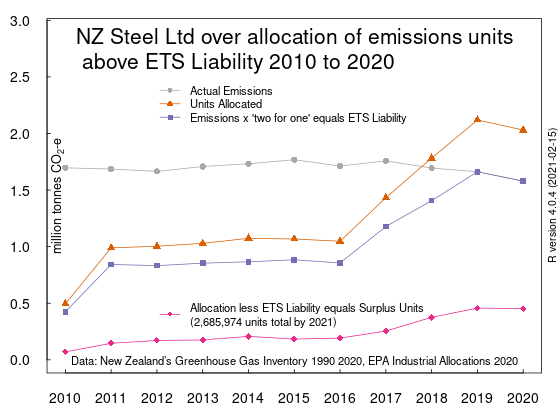
So I need to factor in the discount to estimate the actual liability to surrender units under the Emissions Trading Scheme. That is steel emissions multiplied by a discount factor (0.25 units for a tonne of emissions in 2010 as the ETS applied for half of 2010, 0.5 for 2011 to 2016, 0.67 for 2017, 0.83 for 2018, 1 unit per tonne for 2019 and 2020). I have added the ETS liability in blue lines and square points

Well what do you know? The annual allocation of free emissions units always exceeds the ETS liability to surrender units. New Zealand Steel Limited has never had to surrender any emission units under the ETS. New Zealand Steel Limited is always a net seller of emissions units.

The rationalisation for the annual surplus of units over ETS liability is that New Zealand Steel Limited's 'Allocation Factor' for steel smelting includes an 'Electricity Allocation Factor'. This factor includes the costs associated with the NZ ETS that are expected to flow to eligible firms through electricity prices. So the industrial allocation of units exceeds direct steel smelting emissions. Therefore the carbon price that New Zealand Steel is exposed under the ETS is through the costs of it's electricity supply contracts.

I think that this electricity ETS pass-through cost is an imaginary artefact. It can only be detected by 'modelling'; that is to say fiddling numbers on a spreadsheet. It is confused with coal fired generation setting the marginal cost of electricity in the wholesale market. I think it is implausible that a high-volume contract for electricity supply negotiated by a large corporate such as New Zealand Steel with market power includes any carbon price pass-through cost.

The next graph shows the annual excess or surplus of allocated emission units over the estimated number of emissions units actually surrendered back to the Government.

Back in 2016, I asked why does the Emissions Trading Register show that New Zealand Steel Limited owned over 1 million emission reduction units (internationally sourced, bargain priced and probably fraudulent 'hot air' units) at the end of 2013 and 2014, given it never needed to buy emissions units to meet it's ETS obligations?

The answer is that New Zealand Steel intentionally made windfall arbitrage profits. I argued they would have surrendered the much cheaper "hot air" emission reduction units to the Government for its steel emissions in 2013 and 2014 and stockpiled the more valuable (and permanent in duration) NZUs (New Zealand Units).

Lets add the emission reduction units to our chart as teal green points (and lines) in 2013, 2014 and 2015.

The point being that these units just add to the growing 'stockpile' of units owned by New Zealand Steel. In this next chart I have added the growing stockpile as the red line, resized the Y axis and I have 'grayed out' the annual emissions, the allocations, the ETS surrender liability and the annual surplus of units.

The two biggest annual increases in the stockpile are 2013 and 2014 when New Zealand Steel bought the cheap ERUs and stockpiled the allocated NZUs.

If New Zealand Steel surrendered the cheaper ERUs for it's ETS liabilities and kept all surplus NZU emission units, they would own 4.7 million units at the end of 2020. For their 2022 stock of units that is an under estimate as New Zealand Steel has been allocated more units in May 2021 and in May 2022. The 4.7 million units will have a current market value of $364 million based on a carbon price of $76.90

So my final question is: How can accumulating a holding of emission units worth $364 million possibly be a sensible outcome from a policy intended to incentivise the reduction of greenhouse gas emissions? Instead, the emitter ends up with a financial asset making considerable capital gains and unrealised capital gains income. The effect of the emissions trading scheme is extra annual income to New Zealand Steel - instead of a cost/carbon price. How is this possibly compatible with a net zero in 2050 policy?