04 September 2012

How fast shall we drive over the cliff? More amendments to the New Zealand Emissions Trading Scheme

How fast shall we drive over the cliff

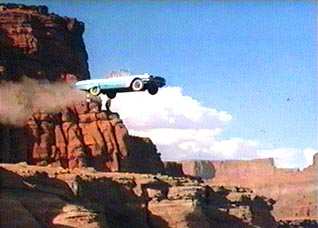
I look at at the Government's amendments to the New Zealand Emissions Trading Scheme and conclude we are arguing about what gear to drive in as we speed towards the cliff. The Government has kindly given us the opportunity to make a submission about how fast fast we should go over the emissions cliff. Time to fasten your seatbelts.

Back in July, Minister for Climate Change Issues Tim Groser announced more watering-down of the New Zealand Emissions Trading Scheme (NZETS).

About a week ago, on 23 August 2012, Groser introduced the amending legislation - the Climate Change Response (Emissions Trading and Other Matters) Amendment Bill.

Consistent with previous emissions trading scheme legislation, the bill will be fully and rationally considered by Parliament's Finance and Expenditure Select Committee in an insultingly short period of time - ten working days. The closing date for public submissions is Monday, 10 September 2012.

What does this ETS amending bill do?

* It indefinitely postpones the entry of pastoral agriculture into the NZETS.

* The 'two-for-one' deal, which halved the number of carbon credits each emitter had to surrender for a tonne of carbon dioxide equivalent greenhouse gases, is extended for another three years. It was to end on 31 December 2012, but will now run on at least to 2015.

* The price cap of $12.50 per tonne ($25 for two tonnes) will also extended. It was to end on 31 December 2012, but will now run on at least to 2015.

What doesn't the bill do?

* It ignores the recommendation from the 2011 ETS review committee to stop the unlimited use of international carbon credits by New Zealand emitters. Which as we know, makes the NZETS the weakest link.

Whats the cliff we are driving off? Well, it's climate change. And it's the price of the New Zealand emissions unit.
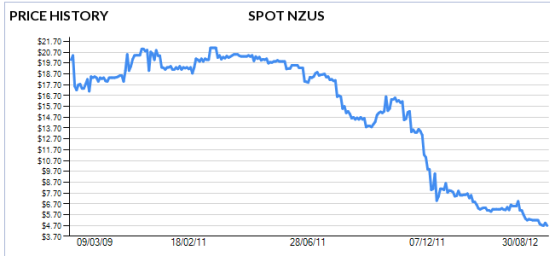
NZ Unit price 2009 to 2012 from OMF Financial Ltd

Who said what about the bill?

Simon Terry of the Sustainability Council said that the NZETS is now in a state of eternal transition".

Helen Clark stated the obvious, that pastoral agriculture must be in the NZETS; “You can’t have your major sector generating greenhouse gases outside the scheme."

Federated Farmers said the deferral of agriculture was huge win for New Zealand's farmers

Business New Zealand seem unusually silent. I guess for them it is all going to plan. Back in July they welcomed Tim Groser's announcement of the delays to the NZETS. So why waste space repeating the message?

However, I do offer some relief from this dreary "business-as-usualism".

Green MP Kennedy Graham has given some strong speeches accurately reflecting both the scientific reality of the cumulative carbon dioxide emissions and the ethical challenge of the failure of politics and governance to respond.

None more so than in his 'first reading' speech in which he summed up the bill thusly.

"Today's bill will defer agriculture indefinitely, defer any increase in the price cap, defer the one-for-one surrender obligation, allow a greater switch from forestry to dairying, and enable importers to increasingly use dangerous synthetic gases. What remarkable, steel-like resolve!"

I do recommend you read Kennedy Graham's speech in full.

Graham, a much more experienced diplomat than Tim Groser, walks us through more than 20 years worth of futile international climate change negotiations, all the while as the relentless accumulation of emissions in the atmosphere uses up the carbon budget consistent with limiting warming to two degrees. And with no faux-realist "get people on the bus" cliches we have come to expect from Tim Groser.

Kennedy Graham concludes that we don't have to accept this state of affairs. He calls on us to make a submission to the Finance and Expenditure Select Committee.

Greenpeace are also saying get stuck in with a submission. What to say?

How about "the NZETS is completely ineffective in reducing GHG emissions due to it's many design flaws - the use of unlimited international junk credits, the delays and exemptions, the partial coverage, the lack of a cap, the price ceiling, the lack of revenue recycling due to the excessive free allocation to emitters."

Something brief and to the point.

However, I will leave the last word to Jeanette Fitzsimons speaking on TV Ones's Q+A: Panel after a Nick Smith/Russel Norman debate back in September 2011.

"Look, its like we are in a very fast car, we are heading towards a cliff, which is getting really close, and we are arguing whether to change from fifth to fourth gear".

28 August 2012

Neil Armstrong coal mines carbon dioxide and global warming the High Court moon walks us to a very hot place

On the same day as the death of Neil Armstrong, the first astronaut to step onto the Moon, became public, the New Zealand High Court moon-walked its way to it's own off-the-world moment. It decided that greenhouse gas emissions and global warming are off-limits in the planning for an open cast coal mine. That's as just as 'out of this world' as denying that the Moon landings ever happened.

On Saturday, two bits of news struck home to me very strongly. The first was the death of moon-landing astronaut Neil Armstrong. The second was the decision of the New Zealand High Court that for new open-cast coal mines, their carbon dioxide emissions and global warming are legally and jurisdictionally unrelated in the Resource Management Act.

The moon landing. I remember very well as a seven year old listening attentively to the 'one small step' broadcast in 1969. The whole class was silent under the spell of our teacher's scratchy transistor radio.

It's one of my most strongly held memories of my childhood. I guess that reflects well on that class of seven-year olds. They stopped playing bullrush, sniffing with colds, and fighting over play-lunchs to listen attentively to the unfolding of one of humanity's most historic moments.

While I was still fondly remembering the Moon landing, the next news item struck.

It was the New Zealand High Court decision barring discussion of carbon dioxide emissions when coal mines seek Resource Management Act consents (see Radio NZ, NBR and TV3 and the Otago Daily Times).

Of course this is about the Perth coal company Bathurst Resources and their Escarpment Mine Project.

Bryan Walker of Hot Topic has posted that this project represents New Zealand doing a Pontius Pilate and washing its hands of the emissions.

I have previously posted that the decisions by councils and the Environment Court to date reflect the zombie ETS infecting the Resource Management Act with climate madness.

My Saturday morning reverie of the Moon landing was rudely stopped and I sort of grumbled to myself;

"Open-cast coal mines and global warming are unrelated!! Thats about as sensible as saying the Moon landings were faked by NASA. Neil Armstrong would just have smacked someone in the face!"

From small half-asleep reactions, blog posts do grow. With the wee footnote that it was actually Buzz Aldrin who punched the Moon landing denier.

I could do a review of the legal issues, but that would be just more legal-climate yadda yadda. I will just note that back in the early 1990s, the Bolger National Government not only considered that greenhouse gas emissions were an adverse effect under the Resource Management Act; they also considered the RMA to be one of the main tools to deal with global warming.

As for the science of it, I will just point to a couple James Hansen charts from his The Case for Young People paper.

The first is cumulative emissions of carbon dioxide. Approving new coal mines adds to cumulative global emissions of carbon dioxide. The second chart shows likely scenarios for temperature. The more carbon dioxide accumulates, the higher the likely temperature.

The facts are that each time a new coal mine is approved, we are just adding to the temperature overshoot above two degrees.

Why is it that the High Court can't apply this simple logic? Why are we even in a position where the High Court can sever the undeniable link between new coal mines, the volumes of carbon dioxide accumulating globally, and the inevitable temperature rise? What has has happened to our legal and planning systems to make this sort of decision possible?

To me this outcome - where the global effects of more GHG emissions are legally severed from approval of a new coal mine - is just as 'out of this world' as denying that the Moon landings even happened.

16 August 2012

Nick Smith blows hot gas for more global warming

What has happened to the hon Dr Nick Smith? The former Minister of Climate Change Issues, A while back he resigned from all his ministerial offices when his conflict of interest in the ACC case of his National-insider friend Brownyn Pullar became public.

Well Nick Smith is back and is promoting the extraction of unconventional gas via hydraulic fracturing.

Smith has written an op-ed in the NZ Herald Fracking the sensible choice for NZ.

Fracking technologies are underpinning an energy revolution in the United States. Huge unconventional shale gas resources in Louisiana and Pennsylvania are coming on stream, enabling gas to replace coal-fired electricity generation. Gas emits one-third the greenhouse gas emissions of coal.

So, according to Smith, from a global warming perspective, unconventional gas is implicitly okay as its emits one-third the greenhouse gas emissions of coal.

Smith concludes that NZ needs;

a strong economy and a clean environment. That will only be possible if we take a rational and science-based approach to our natural resources and risk management.

But promoting unconventional gas development is not the climate science based approach.

Thats abundantly clear from James Hansen's speaking tour of New Zealand in 2011. Did Smith miss these?

Kharecha and Hansen, in their 2008 paper Implications of "peak oil" for atmospheric CO2 and climate. Global Biogeochem. Cycles, 22, GB3012, doi:10.1029/2007GB003142, have clearly told us that we can only keep carbon dioxide concentrations from exceeding about 450 ppm by 2100, if emissions from coal, unconventional fossil fuels, and land use are constrained.

The specific issue of whether a transition to conventional natural gas will actually reduce future greenhouse gas emissions is dealt with in Myhrvold and Caldeira (2012) Greenhouse gases, climate change and the transition from coal to low-carbon electricity.

The Carnegie Institute explains Caldeira and Myhrvold's conclusion; Only the lowest CO2 emitting technologies can avoid a hot end-of-century.

..in the case of natural gas—increasingly the power industry’s fuel of choice, because gas reserves have been growing and prices have been falling—the study finds that warming would continue even if over the next 40 years every coal-fired power plant in the world were replaced with a gas-fueled plant.

As Joe Romm says natural gas is a bridge to nowhere

07 August 2012

New Zealand emissions trading scheme You are the weakest (international) link

This post argues that the New Zealand Emissions Trading Scheme (NZETS) is "the weakest link" due to it's high exposure to the international carbon market. The strong "international linkage" is the the other side of the coin of the uncapped design of the NZETS. Both features reinforce just how ineffective the NZETS is in providing an incentive to reduce greenhouse gas emissions.

Who remembers the The Weakest Link? The quiz show with Anne Robinson the disciplinarian female host with the popular catchphrase "You are the weakest link. Goodbye!"

Yes that's today's bonkers metaphor for another wonky post on the NZETS. In addition to the observation that I would love to say "NZETS you are the weakest link. Goodbye!" there really is a relevant connection to the economics literature.

"Linking" of emissions trading schemes means that units from one ETS can be imported and surrendered by emitters regulated by a different ETS. There are papers and blog posts about international linkage.

The key economic benefit claimed for linking two or more ETS, assuming that they are otherwise sensibly designed, is that the lowest-cost ways of reducing emissions within the linked schemes become available (via emissions trading) to the emitters of the linked schemes.

An example. Pastoral agriculture may or may not have low-cost ways of reducing emissions. If agriculture has relatively high mitigation costs, then you are doing agriculture a favour by including it within a national all-sectors ETS, rather than just in an agriculture ETS. Agriculture can then just buy 'ways of reducing emissions' in the form of units from the cheapest seller - the emitter who can reduce emissions at a lower cost.

Not surprisingly, National's Minister for Climate Change (and Trade), Tim Groser, is very keen on linking international emissions trading schemes. Groser also does not want the New Zealand price for emissions units to be "dislodged" from the international price. Well that wouldn't be lowest-cost, would it?

However, this is all context for two recent reports on the NZETS in the 2011 calendar year. Last Friday, the Ministry for the Environment (MfE) released 'NZ ETS 2011 Facts and figures'. Earlier, in July, the Environmental Protection Authority (EPA) released its report on 2011 unit surrenders and allocations, the Section 89 Climate Change Response Act report.

This table sums up the MfE report.

In 2011, 16.3 million units were surrendered by New Zealand emitters. Of which, 11.7 million units were imported international units (being 4.2 million CERs, 4.3 million ERUs and 3.2 million RMUs.)

Reaction to the Friday's MfE report was swift. Carbon foresters decried the fact that foreign units were swamping the NZ ETS in 2011 at the expense of units from NZ forestry. "..foreign carbon was the credit of choice for emitters in 2011. International credits comprised a whopping 71% of all units surrendered for compliance.."

BusinessDesk noted the that big emitters had chased the cheap foreign carbon units in preference to NZ units as European carbon prices dropped to historic lows, dragging NZU prices as low as low as $4.50 to $5 per tonne of carbon last week.

Another forester said the NZETS was now a Claytons ETS (no doubt having forgotten that Colin James said 'Claytons emissions trading scheme' first).

Kennedy Graham of the Greens said there was no incentive for NZ polluters to reduce emissions. Kennedy hits the nail on the head.

I don't disagree with any of these sentiments. The importing of 11.7 million international units really spells out the "weakest international link" design flaw of the NZETS.

But for me the key point is not the number of units imported, it is that the unlimited importing of international units has been hardwired into the design of the NZETS since the Labour government's 2007 The Framework for a New Zealand Emissions Trading Scheme document.

And if a small market where the compliance demand is 16 million units can import units from the international market where 977 million units exist, then a cap on domestic emissions is never going to be possible.

Thats why the New Zealand Emissions Trading Scheme really is the weakest (international) link.

26 June 2012

Did anyone sign the Kyoto Protocol in good faith? The Kyoto Escalator shows that New Zealand certainly didn't

Robin Johnson's Economics Web Page introduces the Kyoto Escalator chart and argues that New Zealand was just as complicit as the major European countries in negotiating the Kyoto Protocol so that they complied with it without reducing either gross or net emissions.

Kyoto Escalator
New Zealand's Gross greenhouse gas emissions (blue) net emissions (brown) and 'Kyoto' emissions (red) 1990 to 2012. Double click on the chart to see it at 100% and in good resolution.

Professor Dave Frame is the new director of the Climate Change Research Institute at Victoria University of Wellington. He is a University of Canterbury-trained scientist who has worked for some years in Britain. He has just joined the climate change fray with a very interesting opinion editorial "International focus needed over climate" in the Dominion Post. Welcome to climate change issues back in New Zealand, David.

David Frame writes that New Zealand does not want to be thought of as the country that reneges on international treaties.

"Reputationally, accepting commitments and then failing to deliver on them is not a look New Zealand likes. "Doesn't honour the treaties it's signed" is not one of the few sentences we want people to remember about us."

So, yes, I agree, New Zealand should honour the treaties it signs. I hate to nitpick but, isn't New Zealand the country that was explicitly founded in 1840 on a treaty that was not honoured?

David Frame describes the history of the Kyoto Protocol climate negotiations

"...the Kyoto Protocol was a no-win situation for places like New Zealand. In the 1990s Britain and Germany were reducing their emissions of greenhouse gases for non-climate-related reasons (declining manufacturing and the collapse of the coal industry in Britain; technological substitution in the case of post-reunification Germany)."
"Kyoto's structure, reductions of emissions by some specific fraction compared with 1990 levels, were designed with this in mind, since it allowed Europe to appear to "take the lead" without actually doing anything very different from what they were going to do anyway. It was an approach so clearly aligned with the near-term reputational interests of some stakeholders that the Nobel prize-winning strategist Tom Schelling wrote of it: 'I cannot help believing that adoption of such a commitment is an indication of insincerity'."

Frame believes New Zealand's negotiators were innocent parties who acquiesced in these machinations while Britain and Germany portrayed themselves as "leaders" on climate change, even though their emissions reductions basically consisted of doing what they were going to do anyway.

While I am a little disappointed that Britain and Germany acted in such a self-serving way, I don't doubt that David Frame is correct about their motives. However, I don't think he is correct to say New Zealand was innocent. On 31 October 1997, the then Minister of Climate Change Simon Upton gave a speech about New Zealand's negotiating position three weeks before the UNFCCC meeting in Kyoto.

Upton stated that within New Zealand's negotiating position, using forest sinks to offset increases in emissions was just as important as the Protocol including international emissions trading, an all-gases approach and prompt acceptance of commitments by developed countries.

"Sequestration of carbon in sinks (such as forests) should qualify alongside emission reductions for the purposes of counting progress towards any targets that are agreed."

Upton contines.

"I want to say why sinks are important - spelling out in broad terms the economic benefits to New Zealand of counting sinks - and explain briefly how New Zealand considers they ought to be treated. Then I want to say why - even though the correct treatment of sinks is both fair in terms of the Convention, and good for New Zealand's economy - sinks nevertheless do not and cannot protect New Zealand emitters of greenhouse gases from adjustment."
"Adding to carbon stocks through afforestation should count positively; reducing stocks (through forest harvest, land clearance and such like) should count negatively."
"If - and I emphasise if - sequestration is treated in the way New Zealand has long been advocating, then the major contribution we expect to make to removing carbon from the atmosphere in future years will earn us 'credits'."

Upton and the New Zealand negotiators got what they wanted. Forest carbon sink credits were included as offsets. However, Upton provided several cautionary notes. If NZ's forest carbon credits were recognised in Kyoto, it may be perceived as special pleading. Also fairness suggested that forest owners should receive them, and be able to sell them. As opposed to the Government keeping them for compliance with Kyoto.

"New Zealand's stance on sinks has been treated with scepticism by some because, superficially, it looks as though it may be special pleading by New Zealand to take advantage of our sinks to reduce the pressure on emitters to make adjustments. We do not see it that way. New Zealand has been clear in responding to other countries that we do not see the accrual of sink credits as a way to insulate New Zealand from acting to reduce emissions. We see New Zealand's sink credits being an integral part of the international emission trading market. As such, we see New Zealand emitters facing the world price for carbon emissions provided that price is generated by a free market in emission permits."
"Let me now turn to a related question: why recognition of sinks nevertheless does not and cannot protect New Zealand emitters of greenhouse gases from adjustment. It might be suggested that New Zealand's interest in sinks stems purely from a desire to secure for itself a large buffer that would allow for significant growth in greenhouse gas emissions. That is not the case -- nor do I believe would it be credible to pursue such an objective."
"It would simply not be credible to advocate least cost tradeable mechanisms for the world and then seek to keep New Zealand's forest credits for domestic use only. Sequestration credits should accrue to the forest growers who earn them, and they should be free to place them on the world market."

So Simon Upton foresaw two problems with using the credits from forest carbon sequestration as a buffer to allow growth of GHG emissions. There was the reputational problem of New Zealand's insincere negotiating position in the Kyoto discussions. And there was the problem that the credits should accrue to the owners of the forests, not the Government.

New Zealand's climate change officials solved the "who's credits?" problem by inventing a new 'junk' currency to be issued to the commercial foresters instead of Kyoto units (and to buy off greedy emitters); the New Zealand Unit. The real Kyoto forest carbon removal units were kept "off the balance sheet". In the New Zealand Greenhouse Gas Inventory 1990 2009 and in the Kyoto Protocol net position report, the carbon sequestration from 2008 to 2012 is estimated from forest surveys. The actual Kyoto removal units will not be recognised until after 2012. It is these as-yet unissued units that offset the 19% increase in New Zealand's gross GHG emissions since 1990.

It seems since Simon Upton's time, we have developed collective amnesia about intentionally negotiating the Kyoto Protocol so that we could rely on forest carbon sinks to buffer increases in greenhouse gases. Has any one of the Kyoto Protocol parties negotiated and acted in good faith? New Zealand certainly hasn't

24 June 2012

Post card from Skin and Blister on the Euro debt crisis

My sister has lived in Crete for the last two years, which is of course part of Greece. Thats after 25 years in England. Her accent is Estuary English. If you met her, you would think that she is English and probably from East London or Essex, from her accent and peroxided blonde hair. I email her most days with reports on the health of our mother, Ruth.

The other day I emailed her about the Greek elections. I had observed that the Greek elections had led the NZ media cycle for a day or so; mostly in a "News for Gerbils" sort of way. Will the Euro be saved? Will the Euro affect NZ exports?

Lots of breathless news ("Will the Eurozone be saved") about the Greek elections and the swearing in of the new Prime Minister Mr Samaras. OMG. Is it much of a deal where you are?

Her reply was:

re: Greece, all a bit subdued here. We are not Athens or the mainland however so its always been (or seemed) a bit remote here. BIG football game on tomorrow night. however. Euro 2012. Greece versus Germany!! apparently Angela Merkel is going to it and will be in the stands.

Never mind the Greek economic situation, lets watch the football! I understand that Greece was thrashed by the German team 6 - 2.

Here are Clarke and Dawe on the economics of the European sovereign debt crisis. I dedicate this to my apolitical sister.

21 June 2012

Phil O'Reilly of Business NZ flogs the dead horse: ETS stands for Emitters Trading Scheme

Why is only Business NZ putting a proverbial head above the parapet and expressing a view on the New Zealand Emissions Trading Scheme (the NZETS)? I argue that the NZETS gives us the "Eyes Glaze Over" syndrome as it is a flogged dead horse. The NZETS is toothless by design. In both respects, Business NZ has got the NZETS exactly how they want it.

Phil O'Reilly, the CEO of business lobby group Business NZ, has just written an opinion piece in the Herald on the New Zealand Emissions Trading Scheme (the NZETS).

Okay, I think I can guess what you are thinking.

"Oh no, an article about the NZETS...just the mention of it sucks the life out of me. I bet it has attracted a whole lot of crackpot denier comments. It's so complex and full of jargon I don't really know what to think about it. I find the whole subject just a turn-off. My Eyes are Glazing Over.
Yes. This is the entirely natural MEGO response. You need to fight it! Most mentions of the NZETS descend into flogging the dead horse in order for the snake to swallow the elephant in the room.

We need to realise that this ETS-inertia politically assists the parties who gain from the current NZETS. That is of course, the big emitter business members of Business NZ. So, obtain a coffee or other stimulant and return. I can help you through this. I have waded through Phil O'Reilly's NZETS musings so you don't have to.

Turning to Phil O'Reilly's article, at first reading it seems a confusing mix of criticism of the NZETS and also some praise.

The criticisms; NZETS policies are uncertain, there has been lost of tinkering and amending - this is bad for investors and even low carbon investors.

"We need to stop the politicking, get the settings fixed, and just let the ETS get on with it its job."
The praise:
"The framework is fundamentally sound and capable of allowing a stronger price signal to flow through once the international carbon market revives...Major design changes at this point are unnecessary since higher carbon prices are almost certainly on the horizon, especially if Europe recovers."
What on earth is Phil O'Reilly on about? I can't decide which is further from reality; that the NZETS has a sound framework, or that the European economies are about to recover!

However, facts and internal consistency just don't matter in a business op-ed about the NZETS. A bit of criticism is a useful dog whistle to the fringe of climate change deniers. Sure enough, they pop up in the comments section including Hot Topic's favourite energy expert Bryan Leyland. The wingnuts perform the function of making Phil O'Reilly look centrist and therefore reasonable.

And, according to the flogging the dead horse theory, it doesn't matter what you say about the NZETS, the mere mention of it induces ennui. So the more yada yada yada, the better.

But! Let me focus on the bottom-line meta-message from Phil O'Reilly. It is "Hand offs the generous free allocation of emissions units to emitters" as indicated in this quote.

"The allocation of free units allowed under the ETS is not a subsidy but a necessary protection against an uneven playing field."
Business NZ have a history of lobbying very effectively against having an effective carbon price. In particular, for the NZETS, they have lobbied very hard and successfully for generous free allocation of emissions units to big emitters. Its useful to look back at the history of this.

In 2005 Business NZ opposed the proposed carbon tax

They succeeded in getting the tax withdrawn. Clearly, the carbon tax didn't have enough exemptions.

In 2006, Business NZ started "a project to develop a framework for emissions trading". Partners were Business NZ members (and big emitters) Genesis Energy, Mighty River Power, Contact Energy, BlueSkope Steel, Solid Energy, Comalco (now Rio Tinto Alcan NZ), Fletcher Building and Fonterra.

Why were they doing this? Phil O'Reilly said "It's important that the system doesn't harm business competitiveness, and hopefully it can actually enhance competitiveness." One part of the project was to "evaluate and make recommendations on emission credit allocation schemes for different sectors".

In other words, by 2006 Business NZ had already evolved what was to be a highly successful tactic; over-emphasize the competitiveness risks to the big emitters and lobby for generous free allocations of emissions units to the big emitters.

In September 2007, Helen Clark's Labour-led Government released its draft NZETS Framework. In this framework, the free allocation of units to eligible industrial emitters was to be equal to 90 per cent of 2005 emissions plus electricity consumption up to 2012, then decreasing annually on a linear basis so allocation ended in 2025, with no allocation to new industries.

In April 2008, Business NZ said the proposed NZETS allocations did not sufficiently protect the competitiveness of businesses. They catastrophically predicted that the NZETS would would cause 28% to 32% contractions of sheep and wool farming, dairy farming and processing and metals production, causing the loss of 52,000 jobs.

By 2008 Rod Oram was describing their approach thus.

"Business New Zealand says it supports an emissions trading scheme. But it's now clear it means one that transfers most of the costs to consumers and taxpayers."
Business NZ were not even trying to deny this. Passing the cost of the Kyoto Protocol onto taxpayers had been an explicit policy since 2007 when Phil O'Reilly said:
"The government needs to meet the 2012 liability itself rather than multiply its cost many times by passing on to businesses."
Labour stuck with 90% of 2005 emissions for free allocation and the 2025 end-year in the Climate Change Response (Emissions Trading) Amendment Act 2008 which became law in September 2008. Business New Zealand spat the dummy at not getting its way. Phil O'Reilly described the NZETS as "deficient","a risk to our economy" and an "example of poor law-making".

In 2009, the new National Government reviewed the NZETS, and then adopted amendments to it in November.

Brian Fallow noted that the large industrial emitters had got three big wins: a price cap of $25 a tonne to 2012; allocation of free units based on an intensity basis; a more gradual phase-out of free allocations at 1.3 per cent a year not 8.5 per cent.

Phil O'Reilly of course agreed and said "the Government had listened to business concerns about potential economic damage by providing for a more measured transition into a full trading scheme, while still placing a price on carbon."

In February 2010, Business NZ submitted on the development of Industrial Allocation Regulations in their by now time-honoured way, of emphasising free allocation to emitters:

"In the absence of other jurisdictions having emissions trading or carbon taxes, officials need to err on the side of generosity when developing the specific detail around the allocation of free units."
Fast forward to April 2011 and in Business NZ's submission to the David Caygill review of the NZETS they recommended that the $25 price cap and the 1:2 part obligation (which were due to end in 2012) be kept for ten years and that the start of phase out of free allocation be delayed until 2018

In November 2011, when the David Caygill review announced it was recommending slower implementation of the NZETS, Business NZ said the slowdown was welcome but not enough.

In April 2012, the Government announced its intention to keep the $25 price cap until at least 2015 and to have a slower phase out of the 1:2 part obligation to 2012. In other words, they met Business NZ almost halfway.

I think its clear from this review that Business NZ has always taken a tough negotiators position on the NZETS free allocations. They work out what they can reasonably expect, then they always ask for more concessions above that. Then they complain vigourously when they don't get everything they want.

Hence their op-eds seem confusing, contradictory and act as honeytraps for crackpots. But it doesn't matter, as any discussion of the NZETS is enwrapped in a veil of flogging the dead horse.

The ETS in NZETS really does stand for "Emitters Trading Scheme"