Showing posts with label Tim Groser. Show all posts

21 February 2016

Fixing the NZ Emissions Trading Scheme is just flogging the dead horse

The NZETS - how fast shall we drive over the cliff

I look at 'fix the ETS' metaphors and argue that trying to incrementally 'save' or 'fix' the NZ Emissions Trading Scheme will ensure it remains ineffective in reducing domestic emissions for decades. Politically, its just flogging the dead horse. We don't have time for a unending institutionalised cultural conflict over 'fixing the NZETS' like the one we have had for 'fixing' the Resource Management Act.

So, in my last post I used the metaphor or framing of 'arguing over the gears while accelerating towards a cliff' for the latest review of the New Zealand Emissions Trading Scheme.

Other commentators are using a very different framing for the review; that of 'fixing the NZETS'. For me that raises some fundamental questions. What are the political advantages and disadvantages of the two framings? Where will each framing lead us? Which framing is more 'science-informed'?

Brian Fallow, Generation Zero and Geoff Simmons are all accepting the 'fix the NZETS' framing in their comments on the review. Geoff Simmons heads up his second post in two days on the NZETS review How do we save the Emissions Trading Scheme?.

Brian Fallow starts his Herald column "Possible adjustments to the Emissions Trading Scheme aren't much, but at least they'd be a start".

Geoff Simmons and Brian Fallow do a double act of analysis on the NZETS review. I totally respect both Geoff and Brian in their intentions and views and understanding of the NZETS. However they both accept this inherently incremental 'fix the NZETS' framing of the politics. Here's their discussion.

I think this framing, 'fixing the NZETS' is fundamentally wrong in it's politics.

One key point from my last post was that this NZETS review has reversed the burden of proof. The allegedly temporary and allegedly transitional 'moderating features' are now the status quo or the default settings in the NZETS.

Policy analysis and assessment now has to be prepared and presented to show that each flawed 'moderating feature' of the NZETS won’t harm business interests. Queue the technical report Economic impacts of removing NZ ETS transitional measures by New Zealand Institute of Economic Research.

We need to remember there are a lots of 'cost moderating' features (flaws) still in the NZETS: unlimited international linkage and importing of overseas units (access to which officials are trying to restore), overly generous free allocation of units, the hang-over of surplus units in the market, the lack of auctioning (well there is no point having an auction if there is a huge surplus of units).

And the ultimate flaw in the NZETS is that half of New Zealand's greenhouse gas emissions, those from pastoral agriculture, seem to have a permanent get-out-of jail card.

So we have an emissions trading scheme with multiple flaws. The politically selected burden of proof provides a high hurdle for change each time the hapless officials attempt to remove the flaws. All the lobbyists join in as they already have the dates in their calendars.

Also, what is the messaging you need to do if you are promoting long-term incremental reform of the NZETS?

Well, first of all and before explaining your 'fix', you have to try to explain the NZETS from square one for each increment (again and again!). Geoff Simmons gets this as one of his other recent NZETS posts is white board Friday emissions trading for dummies.

The trouble with this is that explaining the NZETS is 95% impossible! I suggest from my own experience that most people find the NZETS the ultimate "My Eyes Glaze Over" topic. Poor old Geoff Simmons better to be ready to do another decade's worth of 'emissions trading for dummies! To borrow a metaphor from the centenary of the First World War, incrementally fixing the NZETS is like winning the trench warfare one shell hole at a time.

Compare that with the explicit message from the fast-car-to-cliff NZETS metaphor. The NZETS is not effective. It is not worth saving. It's got to go. Three four or five word sentences. Message transmitted loud and clear, over.

You need more convincing?. Let's look at one of Tim Groser's last statements as Minister for Climate Change.

First Groser praises Labour for their shared consensus on having an emissions trading scheme.

We have an understanding that there are certain policy frameworks in New Zealand which take decades to put in place, and where you need a very high degree of consensus - particularly amongst the two major parties of Labour and National - on at least a structure of a policy response.

Labour have supped the kool-aid and have bought into this framing. As shown by this statement to Forest and Bird during the 2014 election campaign.

Labour's preferred means of pricing is to fix the the existing ETS. Using an ETS to price carbon is the only broad area of agreement in climate change policy, particularly particularly between the two largest parties (despite National's lip service for an ETS). Labour would not throw that agreement away lightly to start again with a carbon tax.

In other words, Labour will flog the dead horse better than National. As I noted in 2014:

National and Labour in effect have the same policy narrative that explains the problem; 'THEY undermined the NZETS', and a narrative solution, 'WE will fix the NZETS'. This creates the on-going cycle of the 'horse is under performing' and the narrative solution (keep flogging the horse). But beneath the impenetrable detail and complexity of the arguments about fixing the NZETS, it will remain ineffective.

Groser saves his well-known invective for Russel Norman and the Greens and their carbon tax policy. And stretches a very long bow to equate that policy with the Rudd-Gillard-Rudd Australian Labor Prime Ministers' revolving door.

What I didn't appreciate was that Russel Norman - then leader of the Green Party - saying you want to throw the policy structure away and have a carbon tax... I can guarantee you what that would have done - it would have set us back on a cycle of internal political conflict, which would have repeated exactly the problem in Australia.
Groser concluded:

I do not believe there is anything fundamentally wrong with the emissions trading scheme'.

I rest my case that the best science-based and ethically based climate mitigation policy is the opposite of what Groser says!

A 'horse-flogging' process of 'fixing the NZETS' will last a very long time - if it ever concludes. It could just become an social and cultural institution like the never-ending debate over the Resource Management Act. In a previous post I used the metaphor of flogging the dead horse after the snake swallows the elephant in the room to describe this possibility.

Applying the maths of our carbon budgets, Kevin Anderson's analysis and the Paris Agreement, we just don’t have enough time for a never-ending institutionalised horse flogging debate over the NZ emissions trading scheme. The political goal must be to remove the social licence of the NZETS, to de-legitimize it in the eyes of the public and then to scrap it so a simple carbon tax can be adopted instead.

09 July 2015

Tim Groser and New Zealand's impersonation of a 2030 Climate Change Target

Gareth Renowden at Hot Topic covers the release by Minister for Climate Change Issues Tim Groser of the New Zealand 2030 Climate Change Target.

I think we need to understand that this target, just like its predecessors, is a complete fiction. Groser and National have no intention of ever adopting any measure that will make NZ’s greenhouse gases deviate from continued ‘business as usual’ growth.

Note that the Ministry for the Environment's website says; “New Zealand will meet these responsibility targets through a mix of domestic emission reductions, the removal of carbon dioxide by forests and participation in international carbon markets.”

Brian Fallow says the MFE’s (dodgy) economic modelling assumes 80% of the “reduction” will be “met” by buying international carbon units.

On that basis, they can then just repeat the Kyoto Gross-Net forest accounting fudge of saying the baseline is ‘gross’ or total emissions and that the target will be ‘net’ including credits for afforestation and reforestation. There we have it! Zero domestic reductions in emissions.

Note also the very conditional language in the INDC sent to the UNFCCC and in Groser’s press release.

The target is provisional and conditional on 1) access to carbon markets, 2) land use and forest rules NZ agrees with (presumably to keep the Kyoto Gross Net fudge), and 3) effective and affordable mitigation technology for agriculture.

On that basis, New Zealand might start to reduce domestic emissions but only if the rest of the world at the UNFCCC Paris December 2015 meeting bends over backwards to meet Tim Groser’s unattainable provisos.

Whatever approach Paris 2015 takes and whether it “succeeds” or not, the rules of whatever agreement, if there is one, will probably take several more years to thrash out. All of which enables New Zealand to claim the conditions haven’t been met, so no reductions. Even if some perfect rules appear, NZ can say “Sorry our little-battling-punching-above-its-weight Agricultural Research Centre still hasn’t given us affordable mitigation for pastoral agriculture.

This is real “heads we win, tails the atmosphere loses” approach.

19 April 2015

Is it ‘doing our fair share’ to use creative accounting to meet the 2020 climate change target?

I look at how the National Government intends to use creative carbon accounting to ensure that New Zealand meets it’s 2020 climate change target (a five percent reduction from 1990) in spite of a projected trend of increasing emissions of greenhouse gases (GHG) to 2020.

On 10 April 2015, when he was releasing the latest inventory of greenhouse gases, the Minister for Climate Change Issues Tim Groser made this very confident statement about the New Zealand 2020 climate change target; “We’re well on track to meet our 2020 target"

That target is to reduce greenhouse gas emissions to five per cent below 1990 levels by 2020.

When this was announced in 2013 the ambition (-5%) of the target was criticised as useless, pathetic and inadequate.

The five percent reduction stands in stark contrast to the Ministry for the Environments projections of increasing emissions out to 2020. The Ministry estimates that the increase in gross (total) emissions in 2020 will be 29% above the 1990 baseline (from 60 to 77 million tonnes) and the increase in net emissions (gross less any increase in the stock of carbon stored in forests) to 2020 will be 130% (from 33 to 75 million tonnes). So why is Tim Groser so confident that the target will be achieved?

Simon Terry of the Sustainability Council has commented on the ‘kicking the can down the road’ features of the Government’s climate change policies: the mismatch between the emissions target and the predicted emissions, the absence of a credible plan or carbon budget approach and the deferring of liabilities into the future.

Taking Simon Terry’s work as a starting point, I am going to look at how the Government intends to apply the accounting rules for carbon credits to achieve the 2020 target in spite of the likely predicted increase in gross and net greenhouse gas emissions.

So how is New Zealand going to reduce emissions by five percent by 2020?

In December 2014, at the Lima, Peru, climate change conference, the New Zealand climate ambassador Jo Tyndall was asked that specific question. Her answer was that New Zealand plans to meet its 2020 target through a combination of;

  1. domestic emissions reductions,
  2. removal of carbon dioxide by forests,
  3. participation in international carbon markets and,
  4. recognising surplus achieved during the first commitment period of the Kyoto Protocol.

Domestic emissions reductions are unlikely. In 2013, Tim Groser told the Herald that his "strong advice" from officials was that the 2020 target could be met without any changes to settings of the NZ emissions trading scheme (ETS). The relevant Cabinet Paper for the 2020 target also states that the 2020 target can be met without changing policies or ETS costs. In other words, the New Zealand Emissions Trading Scheme will remain in its current induced coma, and stay ineffective in reducing domestic emissions.

New Zealand can’t meet the target by buying carbon credits from international carbon markets as access was blocked at the Doha meeting because we didn’t sign up to a formal Kyoto Protocol second commitment period target.

That leaves two ways of meeting the 2020 target; removal of carbon dioxide by forests, and recognising surplus units from the first commitment period of the Kyoto Protocol. I will look at the removal of carbon dioxide by forests next.

Forest carbon and Kyoto gross-net carbon accounting

By saying “removal of carbon dioxide by forests”, politicians and officials actually mean that carbon credits will be accounted for using the Kyoto Protocol’s gross-net forest carbon accounting rule. This sounds innocuous, if a bit sleep-inducing. It is in fact a method of creative accounting that New Zealand has already relied on to meet the 2008-2012 Kyoto first commitment period target.

The 'baseline’, 1990 emissions, is “gross” - the sum of all emissions without subtracting any “credit” for carbon absorbed into sinks such as growing forests and land use changes. The target (2008 to 2012) emissions are “net", as credits for carbon absorbed in growing forests are recognised and are subtracted from the gross emissions. This is called gross-net accounting. This makes the comparison between baseline and target inconsistent - it is not an “apples with apples” comparison.

I have blogged on this before but Professor Martin Manning, an IPCC author and formerly of the Climate Change Research Institute at Victoria University of Wellington, explained it better in 2012.

..achieving the Kyoto Protocol target can be quite misleading because it compares net emissions over the first commitment period, 2008 – 2012, with the gross emissions in 1990. If one compares the net emissions in 2012 with those for 1990, then the increase in New Zealand has actually been more than 100%.

The National Government intends to repeat this gross net accounting for the 2013 to 2020 target. As long as forest growth exceeds deforestation, this will allow both net and gross emissions to increase up to the quantity of carbon absorbed in forests that was ignored in the 1990 baseline.

The Climate Action Tracker website thinks the credit for carbon absorbed in forests could be up to 25 million tonnes CO2e a year and the ‘recognition’ (under Kyoto rules) of all the units would allow New Zealand gross emissions to increase up to 35% above the 1990 baseline.

Surplus Kyoto units from first Commitment Period 2008 - 2012

Jo Tyndall’s final method of achieving the 2020 target is to recognise surplus units from the first commitment period of the Kyoto Protocol. According to the latest Ministry for the Environment’s net position statement for the Kyoto Protocol, New Zealand will finish the first commitment period (2008-2012) with a surplus of 123.7 million units.

Even though New Zealand has no formal 2013-2020 Kyoto ‘commitment’, the Government intends to ‘carry over’ millions of these surplus Kyoto units to the 2013-2020 period in accordance with the Kyoto Protocol rules.

The carry-over rules are of course complicated, but I calculate that New Zealand will be able to ‘carry over’ almost all of them - 86 million units of the various types of units (see final paragraph - Appendix ‘Carry-over’ of Kyoto first period units).

What’s wrong with having a surplus of units? An effective emissions trading scheme with a real cap would never have surplus units. Units would be scarce and realistically priced. A surplus of units is of itself evidence of a failed implementation of cap and trade frameworks such as Kyoto and the EU ETS.

A surplus of units is one consequence of emissions trading with no cap, unlimited access to international carbon markets and over-allocation of units to industry and a rock-bottom unit price. Which is exactly what we have had with the NZ ETS.

We need to remind ourselves why New Zealand has a surplus of units for the Kyoto Protocol first period. Although net and gross emissions increased, New Zealand gained surplus units by using the gross-net forest carbon accounting rule and allowing the nearly unlimited import of low-priced international units with dubious integrity which were surrendered by ETS participants to match their emissions.

According to Climate Analytics, internationally, the Kyoto first commitment period ended with 14 billion surplus units; enough to allow all the signatory countries to “comply” with their 2020 targets without restricting business as usual emissions growth.

And this is exactly what the Government intends to do.

Each Kyoto unit carried forward will be counted towards New Zealand’s 2020 target and will allow an additional tonne of domestic greenhouse gas emissions above the 1990 baseline.

Similarly, each carbon credit recognised for carbon absorbed in forests between 2013 and 20120 will be counted towards New Zealand’s 2020 target and will allow an additional tonne of domestic greenhouse as emissions above the 1990 baseline.

Conclusion

Our politicians and bureaucrats could have focused on policies to reduce domestic emissions to meet the 2020 target. Achieving the 2020 target won’t be an outcome of policies to reduce emissions. Like fixing the emissions trading system. It will be an outcome of the accounting rules chosen for the carbon credits the Government can hold. That’s called creative accounting.

Appendix “Carry-over” of Kyoto first period units

The Kyoto Protocol has “carry-over” rules for unused units at the end of the 2008 - 2012 first commitment period. Some surplus units may be 'carried over’ to the second commitment period and then be used to comply with a country’s official commitment. Although New Zealand has not taken up a Kyoto second period commitment, New Zealand none the less intends to mimic the application of Kyoto rules designed to carry over surplus units from CP1 to CP2.

New Zealand will have a surplus of 91 million units after transferring 378 million units to a cancellation account for the 378 million tonnes of emissions between 2008 and 2012.

There are limits on which and how many units can be “carried over”. All assigned amount units (AAUs) can be carried over; forest removal units (RMUs) cannot be carried over, carry-over of Certified Emission Reduction units (CERS) and Emission Reduction Units (ERUs) are limited to 2.5% of New Zealand’s initial assigned amount or 7.7 million each. See the UNFCCC Reference Manual

The Government will probably prefer to retire units that cannot be carried over in order to maximise the number it may carry forward.

On that basis, all 72 million RMUs will be cancelled, 37.3 million CERs and 37.3 million ERUs will be cancelled, leaving 7.7 million each of CERs and ERUs carried forward. Then only 231.4 million AAUs need to be cancelled to make up to 378 million units.

The total carried over will be 86 million units composed of 7.7 million CERs, 7.7 million ERUs and 70.6 million AAUs.

16 January 2013

The Kyoto New Zealand break-up - when unfaithful New Zealand said 'commitment' he never meant it

In this post I argue the best analogy for New Zealand's choice to opt out of a second commitment period (of reducing emissions) under the Kyoto Protocol - is: unfaithful men who won't commit to their partners!

New Zealand governments have behaved faithlessly towards Kyoto. The current National Government under Climate Minister Tim Groser won't commit to the Kyoto Protocol stage 2. And the 1990s National Government gave a commitment they had no intention of being faithful to. New Zealand politicians and diplomats intentionally negotiated the Kyoto Protocol so that New Zealand's Kyoto target would be met without reducing either gross or net emissions of greenhouse gases

I have argued before that New Zealand did not sign the Kyoto Protocol in good faith. As we seem unable to commit to Kyoto stage 2 in good faith, I have had another look at how faithful New Zealand's position was right from the the beginnings of Kyoto Protocol negotiations and at ratification in 2002.

According to a UNFCCC account of the Kyoto negotiations 'Tracing the Origins of the Kyoto Protocol: An Article-by-Article Textual History' on page 48;

"New Zealand was the only Party which made an early, more comprehensive proposal on the treatment of sinks, suggesting that sequestration of greenhouse gases from certain listed categories should be added to a Party's emission budget" (paragraph 226)
"New Zealand...faxed through a proposal for the treatment of sinks...sinks would not be included in a Party's baseline, but removals would be credited to a Party's budget (the so-called 'gross-net' approach)." (para 227)

(NB 'Sinks' meaning forests or land-use or land-use-change that sequesters carbon dioxide from the atmosphere. So the New Zealand diplomats were 'ahead of the curve' in negotiating to get forest sinks recognised so they could offset other emissions.)

In October 1997,three weeks before the UNFCCC meeting in Kyoto, Simon Upton, the Minister for the Environment in Jim Bolger's National Government said in a speech:

"New Zealand has long been advocating" for Kyoto rules where "removing carbon from the atmosphere in future years will earn us credits"

Let's look at the advice the Ministry of Foreign Affairs and Trade gave the government in February 2002, prior to New Zealand ratifying Kyoto that year. It was in a document called National Interest Analyses - Kyoto Protocol Part II

"New Zealand has an initial assigned amount for the first commitment period currently estimated to be 365 million tonnes of carbon dioxide-equivalent. That is, New Zealand is allowed to emit 365 Mt of carbon dioxide (or equivalent in other gases) over the years 2008 to 2012...New Zealand is expected to emit between 50 and 75 million tonnes over its 365 Mt initial assigned amount during the commitment period...."
"Current estimates are that, during the commitment period: New Zealand will emit between 415 million and 440 million tonnes of carbon dioxide equivalent, and New Zealand sink activities (derived from forests planted from 1990 onwards) will provide an additional 110 million units of assigned amount, in the form of removal units."
"At a national level, New Zealand is therefore expected to have a surplus of assigned amount over emissions of between 35 and 60 million units over the five years of the first commitment period."

So the Ministry of Foreign Affairs and Trade were saying:

  1. New Zealand's greenhouse gas emissions would increase (not reduce) through to 2012.
  2. New Zealand would meet its Kyoto target by issuing itself additional forest sink removal units.
  3. New Zealand would make an economic gain from having a surplus of emission units.

So New Zealand would meet a 'trifecta' of Kyoto-related goals, none of which were reduced gross or net emissions.

The Ministry of Foreign Affairs and Trade were especially proud of that last point, making a profit.

"New Zealand’s effectiveness in climate change negotiations means it is one of the few developed countries that stands to make a small net economic gain from the first Kyoto Protocol commitment period."

So what would the Ministry of Foreign Affairs and Trade's predicted increased emissions and forest removal units look like on a chart? Assuming the maximum 75 million tonnes of carbon dioxide equivalent greenhouse gases is represented by a linear increase of 0.94% p.a. from a base of 73 million tonnes in 1990, and the forest removal units are issued equally over 2008 to 2012, it looks like this.

This is what 'gross-net Kyoto accounting' of emissions and emission units looks like. From 1990 to 2007, gross (or total emissions - blue dots) are the same as "Kyoto" emissions (the red dots). However, from 2008, you get the "Kyoto" emissions by subtracting carbon dioxide removed by 'human induced afforestation, reforestation and deforestation' (the violet dots) from the gross emissions. And the red dot Kyoto emissions suddenly dive under the 1990 baseline, even though both net and gross emissions have increased.

Except for the straight line, which is from my linear growth assumption, that looks very much like the current gross, net and Kyoto emissions, which I update below in a brand new animated 'Kyoto Escalator' chart

It's interesting to note that in the Ministry for the Environment's November 2012 calculation of the net Kyoto Protocol position, that although the ministry predicts a surplus of units (exceeding the target), this will happen in spite of an estimated 80% increase in annual net emissions since 1990 and a 27% increase in gross emissions. The actual gross and net emissions to 2010 have grown by 19% and 59% respectively, as shown in this chart

This is why whenever we hear Tim Groser or Nick Smith claim the New Zealand is meeting it's Kyoto target, we need to realise they are being the ultimate uncommitted unfaithful partner; in spite of their smooth rhetoric of caring about global warming, New Zealand's gross and net greenhouse emissions are showing an increasing trend. New Zealand needs to adopt policies that really do just stop emissions.

NB The original meme is Kyoto New Zealand break-up and all the images are at Picasa at Kyoto's Break-up with New Zealand where they can be viewed as a slide show. Feel free to use them and make up some more.

20 December 2012

New Zealand's double dealing and special pleading over the Kyoto Protocol second period Tim Grocer special

Is Tim Groser a Kyoto pariah? Or a Kyoto visonary? A global emissions reduction emissary or is he tar-sanded with a Canadian brush? I once more try to make sense of New Zealand's double dealing and special pleading over the Kyoto Protocol second commitment period and the Doha hooha. This time with the aid of Tim Groser, who has written an opinion editorial in the Herald.

Tim Groser, New Zealand's most forthright Minister for Climate Changes, has a shocker of an Op Ed in the New Zealand Herald.

When I first read it, I wrote down my responses to what seemed the most misleading claims. The headline shocker is that either Tim Groser is so out of touch with his portfolio that he has no idea what the current price of carbon in New Zealand, or he is so incompetent that he can't tell US dollars from NZ dollars.

But there are shockers for all of us. I present Groser's quotes in italics and in indented blockquote format, followed by my response in plain text and no indents.

TG: "It's time to move past Kyoto agreement"

Canada o Canada. Groser is channelling Canadian Minister of Environment Peter Kent "Kyoto for Canada is in the past."

TG: "The unrelenting emphasis (on Kyoto) has sucked energy out of debate, diverting attention from the real problem."

This is a classic PR spin tactic of diversion. Groser wishes to divert attention towards the USA, China and India and away from New Zealand's double dealing.

TG "The science, as I interpret it, remains pretty clear"

Yes, Tim Groser does not deny the science, it's just that National and Mr Groser have no intention acting domestically in any way consistent with the science. Perhaps that makes him a 'policy denier'

TG "The international community needs to develop a more robust approach involving far more of the major emitting countries. Whatever New Zealand does will be completely irrelevant unless the major emitters participate."

Canada o Canada "We support a new international climate change agreement that includes commitments from all major emitters. That is the only way we are going to achieve real reductions and real results" Canadian Minister of Environment Peter Kent.

TG "some of the confusion has been deliberate"

Ah the old fifth column within, the extreme green economic traitors, those awkward truth telling ecologists like Mike Joy, Ha I can just find some with other opinions.

TG "First, the ETS has not been "gutted" by the changes passed recently in Parliament"

No, because the NZETS was "gutless" from day 1, as it has no cap, and it always allowed unlimited importing of international units. In 2012, National did defer indefinitely agriculture's entry and extend indefinitely the provisions for half-price emissions for emitters (2-for-1 deal).

TG "No New Zealander - no household, no company - has to pay more, or subsidise anyone because of this decision"

Except New Zealand Aluminium Smelters Limited and Norske-Skog Tasman.

TG "Our top priority is to strengthen the recovery in extremely difficult international economic times."

That really means Groser's top priority always was to have an emissions trading scheme with a more-or-less zero carbon price.

TG "the (NZETS) legislation was, in effect a , a one-way bet taken on the last day of the Labour Government's life in 2008 that the 2009 Copenhagen Summit would deliver a 'single, comprehensive and ratifiable climate change agreement' (the political mantra of the day)."

That statement is a totally revisionist Chairman Mao-like rewrite of history to suit a political agenda. The staggered entry of sectors dates back to Helen Clark's MOU with agriculture signed after the Belch Tax debacle. It also reflects political lobbying by Business NZ and the need to find votes of support from Peter Dunne to get the legislation passed.

TG "We no longer have to pass amending legislation to avoid an automatic ramping up of the scheme, irrespective of either economic conditions or international progress."

By saying this Groser lets us know that for National the delayed entry dates and the apparent all-sectors design were a "Potemkin village". National never had any intention of bringing agriculture into the NZETS.

TG "At current low international carbon prices - they move around but they are clustered around $5 - there is indeed little petrol in the ETS tank. But that is exactly the way it was designed - to be aligned to world prices, whatever world prices are, up to a cap"

To me this is so gobsmacking it's...Hekia Parata. Groser has no idea what the current NZ carbon price is! Groser can't even read the price of a New Zealand unit (NZU) off the Bloomberg website without confusing US dollars and NZ dollars. What an idiot!

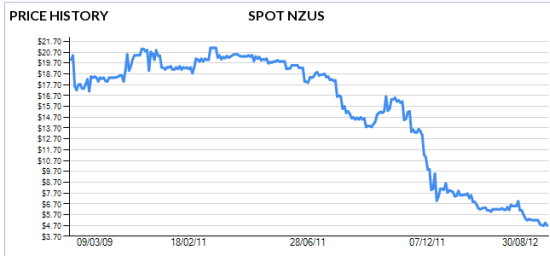
Here is the chart Groser can't read

The NZU price is NOT "around $5" Its around $NZ2.50/tonne

So Tim Groser says the NZETS is designed to import the international carbon price and thats a good thing. If it is so good being wedded to international prices, why has he taken us out of the Kyoto Protocol second commitment period?

TG "The domestic political debate has confused the structure of the policy with the international drivers of the carbon price."

Thats just adding insult to financial injury to the Kyoto forestry sector where some have has lost 80% of the value of the post-1989 Kyoto forests. It's a double blow, as the Government is keeping forestry removal units (earned for the same forests) to itself to fudge the Kyoto net position.

TG "watch what happens to the carbon price when the international recession is over and the EU moves to strengthen carbon markets and, hopefully, more countries start adopting carbon policies. You will then hear, no doubt, the exact opposite of the current political debate. Foresters will be happier as the carbon they sequester becomes more valuable (paper profits unless they sell them) and emitters will be less happy as they pay a higher carbon price."

Thanks for lecture on prices, Tim. By the time the Eurozone has dealt with the over-allocation their carbon markets, and if they ever do, it will be way past 2015 or 2016, and New Zealand won't even be in Kyoto's second commitment period and Tim Groser will probably have canned the NZETS by then anyway!

TG "NZ continues to make remarkable progress in increasing the share of our electricity coming from renewable energy - it is 77 per cent and climbing."

Tim Groser is taking credit for past Ministry of Works hydro projects. Does he really think the public are so stupid as to see that argument as in any way relevant to climate change mitigation? Meanwhile the younger generation are calling for the power shift to 100% renewable electricity. How long until Groser calls them 'extreme greens'?

TG "So is this a great time to put new costs on our major exporting industry when we have a huge need to increase our exports?"

I could say how else could a carbon price work if it is not a real cost? How can any NZ carbon price policy be effective if half the economy is out? This is Groser's and National's real policy bottom-line. Exports uber alles! Exports above all else! National truly and obviously have no intention of pricing New Zealand's domestic greenhouse gas emissions.

TG "Our agriculture sector is, by and large, the most carbon efficient agriculture sector in the world."

Thats very Bruce Wills of him. So agriculture will be fine with a no-exceptions emissions trading scheme or carbon tax.

TG "This is the Global Research Alliance on Greenhouse Gas Emissions, which we lead."

Great but what pays for it? Thats right, taxpayers. So that's a subsidy, then. Having agriculture in the emissions trading scheme would help pay for it.

TG "A few days ago we joined another international initiative on climate change - the Climate and Clean Air Coalition"

Great! so now we mitigate climate change by friending someone's Facebook page. I think I will let William Nordhaus know he doesn't need to run carbon pricing on the DICE global model anymore as it's all on Facebook.

TG "It is time to move beyond Kyoto and find a solution that can have a real environmental impact."

Canada o Canada. "Kyoto for Canada is in the past..","Copenhagen and Cancun agreements, which were negotiated in 2009 and 2010 as the world stared down the end of Kyoto, are the future." Peter Kent, Canadian Minister of Environment.

TG "We are on track to meet or exceed our Kyoto commitment to 2012."

Only because of the "Kyoto escalator" of the gross 1990 baseline for the net target forest fudge.

From 1990 to 2010, New Zealand's gross emissions grew by 20%, from 60 million tonnes (mt) to 72mt. Net emissions grew by 59% (from 32mt to to 52mt (data New Zealand's Greenhouse Gas Inventory 1990-2010) So both gross and net greenhouse gas time series show a relentless upward trend.

So for my conclusion, I might just recycle some from a previous post. But with one difference.
  1. When we hear Tim Groser talking of focusing on a global climate solution that involves 86% of the emitters that can have a real environmental impact, we now know he is just recycling speech notes from Canadian Minister Peter Kent and diverting attention from New Zealand's policy shambles.
  2. Tim Groser and National have absolutely no intention doing anything domestically to reduce emissions of greenhouse gases.
  3. Tim Groser and National also have absolutely no intention of imposing any real carbon price on New Zealand's industrial and agricultural emitters.

19 December 2012

New Zealand's double dealing and special pleading over the Kyoto Protocol second period and the Doha hooha Part 1

Is Tim Groser a Kyoto pariah? Or a Kyoto visonary? A global emissions reduction emissary or is he tar-sanded with a Canadian brush? I try to make sense of New Zealand's double dealing and special pleading over the Kyoto Protocol second commitment period and the Doha climate change talks hooha.

I am very confused about New Zealand's climate change policy since the Doha international climate change talks (COP18) and New Zealand opting out of a second period of the Kyoto Protocol back on 9 November 2012.

The Kyoto part two opt-out is described as a lose-lose decision that shuts New Zealand out of the Kyoto international carbon markets and is a shambles and a disgrace.

So I have a question for all Hot-topic readers.

If Minister of Climate Change Tim Groser is serious about New Zealand's 2020 greenhouse gas target, why would he forego formally lodging the 2020 target into the existing Kyoto Protocol framework (where the national institutions and arrangements are already up and running), in favour of pledging to meet the target on a voluntary basis?

Let me break that question down into several parts.

  1. Imagine you are the Minister for Climate Change in the government of a small developed nation.
  2. This nation has signed an international treaty with a few other nations which states a short-term national target for emissions of greenhouse gases (GHGs).
  3. This nation enacts the treaty by creating some new institutions; a national register for emissions units, national inventories of GHG emissions, national surveys of afforestation, and public servants to report the predicted progress towards the national target.
  4. The nation has adopted several policies relying on the treaty institutions; an emissions trading scheme, forest sink schemes, research alliances, and international trading of emissions units.
  5. The nation has a second publicly stated medium-term target for GHGs for the years following the expiry of the first target.

If you are serious about that second GHG target, why would you pledge the target on a voluntary basis, when you could have formally lodged your target into the existing treaty (where the national institutions and arrangements already exist)?

Any answers? Anyone? Would you like to phone a friend?

Okay, here's a hint. The Parliamentary Commissioner for the Environment has said that we are on track to exceed the 1990 GHGs baseline by 30% rather than meet the 2020 target of reducing GHGs by 10 to 20% compared to 1990.

Figure 3.2 from page 18 of Parliamentary Commissioner for the Environment, “Lignite and climate change: The high cost of low grade coal”, December 2010. Data from MfE 2009. Fifth national communication under the United Nations Framework Convention on Climate Change, Ministry for the Environment, Wellington.

Now just because New Zealand's net emissions are likely to consistently increase through to 2020 doesn't automatically mean New Zealand would not meet the 2020 target if translated into a Kyoto second commitment period target. We could just buy extra emissions units from the international Kyoto carbon markets.

That is, if there was a sensibly designed emissions trading scheme. Such a scheme would be 100% "emitter pays", with emitters making their own market-based decisions to either reduce emissions or to buy the emissions units. Well we certainly don't have that.

So my conclusion is that it is not just that Tim Groser has absolutely no intention doing anything domestically to achieve the 2020 target of a 10 to 20% reduction in GHGs. Groser and National also have absolutely no intention of imposing any real carbon price on New Zealand's industrial and agricultural emitters.

27 November 2012

Tim Groser shuts the stable door after the Mickey Mouse carbon credits have bolted

This week the Ministry for the Environment is consulting and seeking submissions on a proposal to ban some of the more 'Mickey Mouse' international carbon credits from the New Zealand Emissions Trading Scheme. Apparently this is because Climate Change Minister Tim Groser "wants to maintain the integrity of the ETS" (New Zealand Emissions Trading Scheme).

Thats really too much brazen and intentional cognitive dissonance from Groser, especially since he said that only five days after he indefinitely excluded agriculture from the ETS and only four days after he announced New Zealand would not sign up for a second Kyoto Protocol round of binding greenhouse gas cuts.

I apologise if you had an extreme reaction to the close conjunction of the terms "Tim Groser", "emissions trading scheme" and "integrity". So...sorry if you just expurgated your coffee/beer/tea over your laptop or punched out your PC monitor.

Okay, assuming you have cleaned up, I better give you the context for Groser's irony in claiming to be concerned about the integrity of an emissions trading scheme where emission units trade for less than $3 per tonne of carbon dioxide equivalent gas.

Here is the quote from Groser about the consultation.

"The Government has considered whether Emission Reduction Units (ERUs) from HFC-23 and N2O destruction projects, and Certified Emission Reduction Units (CERs) and ERUs from large-scale hydroelectricity projects should be ineligible in the ETS. There are legitimate questions about these types of international units and the Government wants to maintain the integrity of the ETS".

Whoop Dee Doo

This consultation is asking the wrong question. It is ignoring the "elephant in the room" for the NZETS, the rock-bottom price of the international emissions units. Fiddling and faffing about over the specific attributes of some subset of the allowable international units, when all the international units are under-priced and over-supplied, is just shutting the stable door after the horse has bolted.

We have already been through one futile cycle of banning a few dodgy international units with Groser's predecessor Nick Smith. And that didn't make the slightest bit of difference to the NZ price.

Just before Christmas 2011, Nick Smith authorised the Ministry for the Environment to ban certified emissions reduction units (CERs) from the UN Clean Development Mechanism projects destroying HFC-23 and N2O from the NZETS. There is no doubt that the gas-destruction CER units did not represent real removal of greenhouse gases and that the awarding of CERs was incentivising the deliberate extra production of HFC-23 and N2O.

According to Wikipedia at September 2012 about 418 million CERs had been issued for HFC-23 destruction and about 214 million CERs had been issued for N2O destruction. So in theory that took 632 million CER units out of the picture for the NZ market.

However, as of today there are 1,061,399,151 issued CERs. So with 60% of the CERS banned from the NZETS, there were still 429 million (1061m - 632m) that could still be imported to NZ.

In terms of influencing the carbon price in world's worst ETS and in the world's smallest and most open carbon market (where 2011 demand from emitters was 16 million units), it makes no difference whether quantity of available CERS is 429 million units, 1 billion units or 10 billion units. The international price will still set the domestic NZ price.

Another day, another potentially eyes-glazing-over carbon credit three letter acronym; the E.R.U. These Emissions Reduction Units, are units from UN Joint Implementation projects located in Kyoto Protocol Annex 1 countries. It's similar to the less-developed countries Clean Development Mechanism, except that Joint Implementation projects tend to be in the Former Soviet Union countries.

As of today about 250 million units have been issued. About 80 million ERUs (or 32 percent) are for HFC-23 and N2O destruction. So if these gas ERUs were banned from the NZETS, there would still be 172 million under-priced ERUs able to satiate New Zealand's demand for international units.

The number of CERs issued to large hydroelectricity projects CERS at 1 November was 108 million, or 10% of the 1.061 billion CERs total. Again, this proposed ban would make no real difference to the international over-supply or to the NZ price.

Submissions can be made until 5.00pm this Friday 30 November 2012 and can be can be emailed to climatechange@mfe.govt.nz or posted to Ministry for the Environment, PO Box 10362, Wellington 6143.

I have not drafted my submission but it will roughly say: the proposal is slamming the stable door after the horse has bolted, and that it ignores the 'elephant in the room' - the flawed design of the NZETS which imports the collapsed international carbon price into the New Zealand carbon price. And conclude that NZ should move to a all-sectors no-exceptions no-offsets carbon tax ASAP.

The outcome of the consultation will of course be to adopt the partial ban.

04 September 2012

How fast shall we drive over the cliff? More amendments to the New Zealand Emissions Trading Scheme

How fast shall we drive over the cliff

I look at at the Government's amendments to the New Zealand Emissions Trading Scheme and conclude we are arguing about what gear to drive in as we speed towards the cliff. The Government has kindly given us the opportunity to make a submission about how fast fast we should go over the emissions cliff. Time to fasten your seatbelts.

Back in July, Minister for Climate Change Issues Tim Groser announced more watering-down of the New Zealand Emissions Trading Scheme (NZETS).

About a week ago, on 23 August 2012, Groser introduced the amending legislation - the Climate Change Response (Emissions Trading and Other Matters) Amendment Bill.

Consistent with previous emissions trading scheme legislation, the bill will be fully and rationally considered by Parliament's Finance and Expenditure Select Committee in an insultingly short period of time - ten working days. The closing date for public submissions is Monday, 10 September 2012.

What does this ETS amending bill do?

* It indefinitely postpones the entry of pastoral agriculture into the NZETS.

* The 'two-for-one' deal, which halved the number of carbon credits each emitter had to surrender for a tonne of carbon dioxide equivalent greenhouse gases, is extended for another three years. It was to end on 31 December 2012, but will now run on at least to 2015.

* The price cap of $12.50 per tonne ($25 for two tonnes) will also extended. It was to end on 31 December 2012, but will now run on at least to 2015.

What doesn't the bill do?

* It ignores the recommendation from the 2011 ETS review committee to stop the unlimited use of international carbon credits by New Zealand emitters. Which as we know, makes the NZETS the weakest link.

Whats the cliff we are driving off? Well, it's climate change. And it's the price of the New Zealand emissions unit.

NZ Unit price 2009 to 2012 from OMF Financial Ltd

Who said what about the bill?

Simon Terry of the Sustainability Council said that the NZETS is now in a state of eternal transition".

Helen Clark stated the obvious, that pastoral agriculture must be in the NZETS; “You can’t have your major sector generating greenhouse gases outside the scheme."

Federated Farmers said the deferral of agriculture was huge win for New Zealand's farmers

Business New Zealand seem unusually silent. I guess for them it is all going to plan. Back in July they welcomed Tim Groser's announcement of the delays to the NZETS. So why waste space repeating the message?

However, I do offer some relief from this dreary "business-as-usualism".

Green MP Kennedy Graham has given some strong speeches accurately reflecting both the scientific reality of the cumulative carbon dioxide emissions and the ethical challenge of the failure of politics and governance to respond.

None more so than in his 'first reading' speech in which he summed up the bill thusly.

"Today's bill will defer agriculture indefinitely, defer any increase in the price cap, defer the one-for-one surrender obligation, allow a greater switch from forestry to dairying, and enable importers to increasingly use dangerous synthetic gases. What remarkable, steel-like resolve!"

I do recommend you read Kennedy Graham's speech in full.

Graham, a much more experienced diplomat than Tim Groser, walks us through more than 20 years worth of futile international climate change negotiations, all the while as the relentless accumulation of emissions in the atmosphere uses up the carbon budget consistent with limiting warming to two degrees. And with no faux-realist "get people on the bus" cliches we have come to expect from Tim Groser.

Kennedy Graham concludes that we don't have to accept this state of affairs. He calls on us to make a submission to the Finance and Expenditure Select Committee.

Greenpeace are also saying get stuck in with a submission. What to say?

How about "the NZETS is completely ineffective in reducing GHG emissions due to it's many design flaws - the use of unlimited international junk credits, the delays and exemptions, the partial coverage, the lack of a cap, the price ceiling, the lack of revenue recycling due to the excessive free allocation to emitters."

Something brief and to the point.

However, I will leave the last word to Jeanette Fitzsimons speaking on TV Ones's Q+A: Panel after a Nick Smith/Russel Norman debate back in September 2011.

"Look, its like we are in a very fast car, we are heading towards a cliff, which is getting really close, and we are arguing whether to change from fifth to fourth gear".

07 August 2012

New Zealand emissions trading scheme You are the weakest (international) link

This post argues that the New Zealand Emissions Trading Scheme (NZETS) is "the weakest link" due to it's high exposure to the international carbon market. The strong "international linkage" is the the other side of the coin of the uncapped design of the NZETS. Both features reinforce just how ineffective the NZETS is in providing an incentive to reduce greenhouse gas emissions.

Who remembers the The Weakest Link? The quiz show with Anne Robinson the disciplinarian female host with the popular catchphrase "You are the weakest link. Goodbye!"

Yes that's today's bonkers metaphor for another wonky post on the NZETS. In addition to the observation that I would love to say "NZETS you are the weakest link. Goodbye!" there really is a relevant connection to the economics literature.

"Linking" of emissions trading schemes means that units from one ETS can be imported and surrendered by emitters regulated by a different ETS. There are papers and blog posts about international linkage.

The key economic benefit claimed for linking two or more ETS, assuming that they are otherwise sensibly designed, is that the lowest-cost ways of reducing emissions within the linked schemes become available (via emissions trading) to the emitters of the linked schemes.

An example. Pastoral agriculture may or may not have low-cost ways of reducing emissions. If agriculture has relatively high mitigation costs, then you are doing agriculture a favour by including it within a national all-sectors ETS, rather than just in an agriculture ETS. Agriculture can then just buy 'ways of reducing emissions' in the form of units from the cheapest seller - the emitter who can reduce emissions at a lower cost.

Not surprisingly, National's Minister for Climate Change (and Trade), Tim Groser, is very keen on linking international emissions trading schemes. Groser also does not want the New Zealand price for emissions units to be "dislodged" from the international price. Well that wouldn't be lowest-cost, would it?

However, this is all context for two recent reports on the NZETS in the 2011 calendar year. Last Friday, the Ministry for the Environment (MfE) released 'NZ ETS 2011 Facts and figures'. Earlier, in July, the Environmental Protection Authority (EPA) released its report on 2011 unit surrenders and allocations, the Section 89 Climate Change Response Act report.

This table sums up the MfE report.

In 2011, 16.3 million units were surrendered by New Zealand emitters. Of which, 11.7 million units were imported international units (being 4.2 million CERs, 4.3 million ERUs and 3.2 million RMUs.)

Reaction to the Friday's MfE report was swift. Carbon foresters decried the fact that foreign units were swamping the NZ ETS in 2011 at the expense of units from NZ forestry. "..foreign carbon was the credit of choice for emitters in 2011. International credits comprised a whopping 71% of all units surrendered for compliance.."

BusinessDesk noted the that big emitters had chased the cheap foreign carbon units in preference to NZ units as European carbon prices dropped to historic lows, dragging NZU prices as low as low as $4.50 to $5 per tonne of carbon last week.

Another forester said the NZETS was now a Claytons ETS (no doubt having forgotten that Colin James said 'Claytons emissions trading scheme' first).

Kennedy Graham of the Greens said there was no incentive for NZ polluters to reduce emissions. Kennedy hits the nail on the head.

I don't disagree with any of these sentiments. The importing of 11.7 million international units really spells out the "weakest international link" design flaw of the NZETS.

But for me the key point is not the number of units imported, it is that the unlimited importing of international units has been hardwired into the design of the NZETS since the Labour government's 2007 The Framework for a New Zealand Emissions Trading Scheme document.

And if a small market where the compliance demand is 16 million units can import units from the international market where 977 million units exist, then a cap on domestic emissions is never going to be possible.

Thats why the New Zealand Emissions Trading Scheme really is the weakest (international) link.