31 August 2019

If we can't tidy up the NZ emissions trading scheme can we tidy up the dataframe of the free allocation of units

I do some data cleaning and tidy up the EPA's table of 2018 free giveaway emissions units.

In this follow up post about the EPA's non-tidy table of 2018 industrial allocation/free giveaway of emissions units, I use a great opensource programme OpenRefine to tidy the allocation data into a 'tidy' format of 'each variable is a column, each row is a an observation and each cell is a value'.

I have recorded my commands as much for my own benefit in the future if and when I try to replicate the commands. There's a joke in the reproducible research online community "the hardest person to email questions to is yourself three years ago".

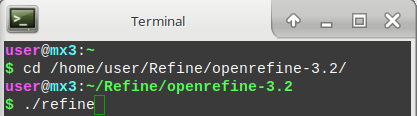
Assuming you have installed OpenRefine to your Linux Debian based operating system, open a terminal window and type:

cd /home/user/Refine/openrefine-3.2/

Type './refine' and press enter

Wait for Firefox to start at IP http://127.0.0.1:3333/ which will start OpenRefine

Go to the Google sheet obtained from the EPA webpage https://docs.google.com/spreadsheets/d/1arfDpqiXg84SwTAiY5TWzDxOJNrnJxvG9GgyBY8jCRM/ and download the .csv file to '/home/user/Downloads'

Copy the downloaded .csv file to /home/user/Refine/openrefine-2.6-beta.1/

Go back to Firefox and enter "http://127.0.0.1:3333/" into the address bar. That will open OpenRefine.

In OpenRefine, select the button "Create a project by importing data"

Browse to and select /Refine/openrefine-2.6-beta.1/NZ-emission-unit-industrial-allocation-decisions-EPA-2018 - Sheet1.csv

Click on 'Next' button and 'create new project'

Select and tick 'ignore first line at the beginning of the file

Tick 'Parse next 1 line as column headers'

Click on 'create new project'

We should have 108 rows of data - look at the second column, it mixes two variables, 'Applicants name' and 'Activity'

Edit column - Add new column 'Activity' based on column *Activity and Applicant's Name* - add name 'Activity'

write " if(value.startsWith("*"), value[1,37],"")" into the Expression box. That moves only the activities into their own column.

Edit column, Add column based on column Applicants Name called 'Name'

in the Expression box , leave 'value' in box and copy the column by selecting 'ok'

Select Activity column, edit cells, fill down (fills all Activities to empty cells)

Edit column - Add new column 'Year' based on column *Activity and Applicant's Name* - add name 'Year' and value '2018' in expression box

Select the header *2018 Final Unit Entitlement*, edit cells, common transforms, to number

Select the header *2018 Final Unit Entitlement*, select Facet, numeric facet, go to left side of dashboard, untick 'numeric' box, leave 'blank' box (24 records) ticked,

Select column 'All', then Edit rows, remove all matching rows (that leaves 84 rows with no blank cells in *2018 Final Unit Entitlement*)

Select column *Activity and Applicant's Name*, Edit column, Remove this column

Select column *Activity", Edit column - Add new column 'Activity' based on column 'Activity2' - add name 'Activity' and expression in box enter value.replace("*","") - to remove the *. And we have a tidy data table!

Click on the data project name at the top and just right of the "OpenRefine" label "NZ-emission-unit-industrial-allocation-decisions-EPA-2010-2018-Sheet1-csv". Change the name to "NZ emission unit industrial allocation decisions EPA 2018 tidy"

Select 'Export' (in top right corner) as a .csv file

Upload the csv file to Google Drive via the Gdrive command line utility

Open a xterminal window, for first upload enter;

gdrive upload /home/user/Refine/NZ-emission-unit-industrial-allocation-decisions-EPA-2018-tidy.csv

In Google sheets i changed the file's name to "NZ-emission-unit-industrial-allocation-decisions-EPA-2018-tidy" and I 'shared' the file to 'public'.

Download the file to your computer and open it with a spreadsheet program such as gnumeric.

We can see that we now have a tidy dataframe where each variable is a column, each row is a an observation and each cell is a value - the number of emissions units given away for free to greenhouse gas emitters under the NZ emissions trading scheme.

25 August 2019

Industrial allocation of ETS emissions units to emitters is subsidizing polution forever

On 31 July, the indefatigable Idiot/Savant of No Right Turn blog reported that the Government had decided to start a very gradual phase-out of 'free allocation' of emissions units to industrial emitters.

The media statement released by James Shaw states:

"The plan is to begin phasing down industrial allocation at 1 per cent per year from 2021-2030, then at 2 per cent from 2030-2041, and at 3 per cent per year from 2041-2050".

To quote Idiot/Savant:

"And when you do the maths, it means the government will still be subsidising highly intensive industrial polluters by 20% of their emissions in 2050, the year we're supposed to be at net-zero emissions.
This is bullshit, simply bullshit. And it is bullshit neither the country nor the planet can afford".

Idiot/Savant termed this "Pollution forever". I agree with him. This is just an appalling policy. Every emission unit given for free to an emitter is a right to emit one tonne of greenhouse gases. Its a voucher for pollution. It's worse than that, it's an instruction to pollute. Every unit allocated represents a blunting of the price incentive to reduce emissions. It's exactly the same as the Government giving the emitters petrol (or coal) vouchers paid for by the taxpayer. I am amazed that James Shaw can even put his name to this policy.

Idiot/Savant is the only blogger, or commentator for that matter, in New Zealand, who is regularly providing hard analysis of climate change and emissions trading scheme policy. In a further post, he looks at how the free industrial allocation of units will benefit New Zealand's largest industrial emitters; NZ Steel, New Zealand Aluminum Smelters Ltd, Ballance Agri-Nutrients (Urea) and Methanex (methanol).

In this post, I am going to go through the steps to obtain the latest data, for the 2018 calendar year, of free allocation of emissions units from the webpage of the NZ Environmental Protection Authority. And then upload it to Google sheets.

Here is the EPA webpage listing the final annual allocations from 2010 to 2018.

Okay, we need to scroll down and expand the tabs to see the data.

We see that the industrial activity of aluminium smelting always leads off. New Zealand Aluminium Smelters Limited received 1.3 million units for 2018. Alphabetical order is after all the text version of linear progression.

The EPA web site has a copyright statement saying that a Creative Commons International Attribution licence applies to their website.

And Section 86B "Decisions on applications for allocations of New Zealand units to industry and agriculture" of the Climate Change Response Act requires the EPA to publish the final allocation numbers in the Gazette and on the EPA website.

So the industrial free allocation data is intended to be available to and used by the public. However, the EPA does not provide a link for downloading the data in an 'open data' format such as text, .csv or spreadsheet. There is a table. However it is not in a 'tidy' format. The variable denoting the industrial activity for which the emitter is eligible for allocation has a row to itself. In a tidy format, each variable would be a column and each observation a row.

To obtain the data, I am going to repeat a 'webscrape' I have used before. I create a new google sheet. I insert the url of the EPA Industrial allocation decision webpage into cell 'A1'. I insert the text '=importhtml(A1,"table",1)' into cell A2. And the full table of the 2018 year unit allocation data appears in the sheet.

The next step will be cleaning the data to make it 'tidy' Then some data analysis. That can be a new post.

13 August 2019

Inaction on Agriculture - pastoral agriculture gets feather bedded into the emissions trading scheme

At 4:58 p.m., two minutes before the deadline, I uploaded my submission to the Ministry for the Environment's In Action on Agriculture consultation.

This is about the Government's response to the first report of the Interim Climate Change Committee. The proposal is extremely disappointing. It involves 'feather bedding' New Zealand's pastoral agriculture sector into the emissions trading scheme by giving the public a Hobson's choice of two completely compromised proposals.

First weak option; agriculture joins the emissions trading scheme from 2025 with the weakest obligation possible (i.e. after a free allocation of emissions units equal to 95% of emissions - and at the most complex way possible - at farm level.

Or - the second weak option; the industry runs their own scheme, also based on a free allocation of emissions units equal to 95% of emissions at farm level from 2025.

The Ministry helpfully provides a set of questions submitters have to navigate through. Some of which pre-suppose certain limits to the answers. I have underlined each question and then provided my response.

1. What is the best way to incentivise farmers to reduce on-farm emissions?

I do not agree that this is the correct question to ask. The framing of the question pre-supposes the answer. The more objective, neutral and policy-relevant question is "What are the best policies to reduce emissions from the pastoral agriculture sector?"

I consider that the proposals are compromised and inadequate responses to the urgent need to reduce agricultural emissions. They are clearly not fit for purpose.

The proposals are so weak in terms of price, scope, timeliness, exceptions, excessive unit allocations, complexity and difficulty of implementation - that they are worse than doing nothing.

The proposals, if implemented, would undermine the role of the yet to be established Independent Climate Commission by predetermining the agricultural emissions targets and 5 year budgets.

I recommend that neither proposal is accepted.

I recommend that pastoral agriculture be entered into the emissions trading scheme at processor level from 2020 with no free allocation of emissions units.

2. Do the pros of pricing emissions at farm level outweigh the cons, compared with processor level, for (a) livestock and (b) fertiliser? Why or why not?

Even the consideration of pricing emissions at farm level is the incorrect framing to apply. Farm level pricing would not be fit for purpose. It is highly problematic in terms of price, scope, timeliness, exceptions, excessive unit allocations, complexity and difficulty of implementation. Processor level pricing is efficient and sends an effective emission price back through the value chain.

3. What are the key building blocks for a workable and effective scheme that prices emissions at farm level?

There are no feasible building blocks for a workable and effective scheme that prices emissions at farm level. The framing of this question is not appropriate as it presupposes the outcome.

The notion of a "workable and effective scheme that prices emissions at farm level" is currently a figment of the imagination.

From the point of view of establishing reasonably effective policy, it has become an unrealistic and unachievable expectation of 'best' policy. In this consultation, it has the role "letting the perfect be the enemy of the good" and being given as a reason to try to implement the most difficult , the most time-consuming and most impractical point of obligation.

4. What should the Government be taking into consideration when choosing between Option 1: pricing emissions at the processor level through the NZ ETS and Option 2: a formal sector-government agreement?

The Government should be considering the interplay of the 2019 'zero carbon bill' debate and of the dogged determination of the pastoral agriculture interests to avoid any regulation of their emissions.

I question the utility of negotiating a detailed ETS/emissions policy agreement with pastoral agriculture sector, when the pastoral agriculture organisations do not accept or agree with the higher level goal - the proposed 2050 methane target in zero carbon bill. How can there be a 'partnership' approach when the partners do not even agree what the methane target is?

Dairy NZ, Federated Farmers, and Beef and Lamb NZ have a uniform and consistent position of opposing any methane target above 'business as usual' incremental changes in efficiency. The only mitigation they will tolerate will be technology-based 'supply side' reductions in intensity in per unit of output. Such technology has been researched at the tax payers expense for about a decade.

In short, their position on New Zealand's 'zero carbon' targets, is that there should be no absolute reduction in methane emissions, no absolute reduction in stock numbers and no changes in land use in the pastoral sector to lower-emission land use.

Given the firmly and repeatedly articulated viewpoint of the pastoral lobby, I was very surprised on 16 July 2019, to read about Ministers Shaw and O'Connor announcing "Consensus reached on reducing agricultural emissions".

This must a different definition of 'consensus' than the one from my dictionary. The Ministers and the pastoral lobby have opposite views on the proposed 2050 methane target in the zero carbon amendment bill. How can a partnership compromise proceed without agreement on the basic methane target?

The tactics of the pastoral agricultural lobbyists are clear; to delay policy timing/implementation by promoting the problematic farm-level obligation and to minimise policy scope by including minimal targets and exceptions/discounts through excessive free allocation of units. Then wait out a period of 'wet bus ticket' compromised and ineffectual policy until it is removed by the next National-led Government.

Todd Muller of the National Party is on record that the next National government will lower the 2050 the methane target (speech to Federated Farmers Taranaki AGM in Stratford on 24 May) and that National will never put pastoral agriculture in the emissions trading scheme (interview with Jack Tame of 'Q & A' on 23 July).

If the proposed 2050 methane target is lowered to about 20% over 30 years (the same as past efficiency gains), as Dairy NZ, Federated Farmers, and Beef and Lamb NZ have submitted, I absolutely question if is there any point adopting either proposal.

Research into mitigation of agricultural emissions

The Productivity Commission (2018) on pages 312 and 313 notes that the Government invests roughly $20 million each year into mitigation research, most of which helped fund three research centres.

1. The Pastoral Greenhouse Gas Research Consortium, set up in 2003.
2. The New Zealand Agricultural Greenhouse Gas Research Centre, established in 2009.
3. The Global Research Alliance on Agricultural Greenhouse Gases (GRA) in 2009.

As a taxpayer, I do not begrudge the significant investment of tax that has been invested in researching mitgation technologies for methane and nitrous oxide. I accept that the benefits could help many countries. However, I do not see that research can be a substitute for mitigation for an indefinite time.

I consider that indefinite time has passed and there is a 'quid pro quo' that applies. Given the research funding, and given the past decade-long exemption of agriculture from the ETS, I think it is now unconscionable for pastoral agriculture to be evading emissions reduction policies. I consider this applies whether the evasion of policies is - by seeking a 'zero methane' target or by seeking 95% free allocation of units or by seeking farm-level point of obligation. This just isn't acceptable.

5. As an interim measure, would Option 1: pricing emissions at the processor level through the NZ ETS with recycling of funds raised back to the sector to incentivise emissions reduction or Option 2: a formal Government-industry agreement for reducing emissions be best? Why?

What will be best will be emissions pricing implemented on the basis of standard economics principles such as 'pricing the externality', 'polluter pays', 'finite emissions cap' and 'processor level point of obligation'.

I recommend that pastoral agriculture be entered into the emissions trading scheme at processor level from 2020 with no allocation of emissions units.

6. What additional steps should we be taking to protect relevant iwi/Māori interests, in line with the Treaty of Waitangi?

The Ministry should already have carried out a suitable process of consultation with iwi and hapu. The consultation document does not mention any consultation. I find that unsatisfactory. The Ministry should be taking into account the principles of the Treaty of Waitangi. That requires, at a minimum, consultation. The Productivity Commission 2018 report into the low emissions economy discussed issues affecting iwi and hapu and it is a poor reflection on the consultation document that it doesn't.

7. What barriers or opportunities are there across the broader agriculture sector for reducing agricultural emissions? What could the Government investigate further?

The main barriers to reducing agricultural emissions are the pastoral agricultural lobbyists Dairy NZ, Federated Farmers, and Beef and Lamb NZ and their preferred political party the National Party. Their positions and actions and statements show that they are a generation behind urban New Zealanders (and many farmers) in terms of responding to climate change. They say they accept the science and that it supports their position of no policy and no absolute reduction in emissions. And that they are already the world's most efficient farmers. They are, to coin a term, 'mitigation deniers'.

The Government should investigate "less cows" - which is otherwise known as 'demand side management' or changes in land use (to lower emissions uses).

The ICCC report only mentions the option of change in land use once in it's report. Todd Muller has even embarrassed himself in stating to TV One, to Radio New Zealand that Te Papa is not allowed to mention "less cows" in the context of a exhibition on declining water quality.

8. What impacts do you foresee as a result of the Government’s proposals in the short and the long term?

In the short term the implementation of either proposal will involve almost insurmountable practical difficulties that will result in no practical reduction in greenhouse gas emissions from pastoral agriculture.

Nor will the Government be thanked for it's compromise. It will only earn further scorn from the agriculture sector for 'imposing' an 'impractical' policy on them. There is nothing some agricultural interests like more than criticising governments and bureaucrats for not being 'practical'.

In the long term the implementation of either proposal will be remembered as yet another failed implementation of emissions pricing where the political lobbying of the sector's vested interests prevented effective policy.

15 July 2019

Dont forget to submit on the Climate Change Response (Zero Carbon) Amendment Bill

Submissions of the Climate Change Response (Zero Carbon) Amendment Bill can be made til the end of tomorrow via the New Zealand Parliament Pāremata Aotearoa

By far the best submission I have seen so far is the submission from Generation Zero. Its very good.

Here is my submission

Detailed comments and recommendations

I wish to start my submission with this point from ‘Global Warming of 1.5°C. An IPCC Special Report’ which states:

"Reaching and sustaining net zero global anthropogenic CO2 emissions and declining net non-CO2 radiative forcing would halt anthropogenic global warming on multi-decadal time scales (high confidence). The maximum temperature reached is then determined by cumulative net global anthropogenic CO2 emissions up to the time of net zero CO2 emissions (high confidence) and the level of non-CO2 radiative forcing in the decades prior to the time that maximum temperatures are reached (medium confidence). On longer time scales, sustained net negative global anthropogenic CO2 emissions and/ or further reductions in non-CO2 radiative forcing may still be required to prevent further warming due to Earth system feedbacks and to reverse ocean acidification (medium confidence) and will be required to minimize sea level rise (high confidence)."

To me the IPCC 1.5°C Report makes it clear that while emissions of the greenhouse gas methane need not be reduced to zero emissions, they must nonetheless be significantly reduced in conjunction with net zero carbon dioxide emissions in order to halt warming and to prevent future warming. There is no credible argument grounded in science for methane to have either no target or a target of zero.

Purpose of the legislation

The purpose of the bill should be explicitly consistent with Paris Agreement 1.5C goal that New Zealand has agreed to via our ratification of that agreement. I do not think the suggested new subclause (aa) is sufficiently clear in stating the purpose of the bill.

In Section 3 amended (Purpose) of the bill, I request that before section 3(1)(a), sub-clause: (aa)

"provide a framework by which New Zealand can develop and implement clear and stable climate change policies that contribute to the global effort under the Paris Agreement to limit the global average temperature increase to 1.5° Celsius above pre-industrial levels"

be replaced with:

"The purpose of the act is to;
a) to limit the global average temperature increase to 1.5° Celsius above pre- industrial levels; and
b) to provide a framework by which New Zealand can develop and implement clear and stable climate change policies that give effect to the Paris Agreement and
c) to establish finite cumulative greenhouse gas budgets for New Zealand that are an equitable and fair share of a global finite cumulative greenhouse gas budget consistent with limiting the global average temperature increase to 1.5° Celsius above pre-industrial levels, and
d) to establish a 2050 net zero target and a series of five year emissions pathway budgets consistent with these purposes."

Inclusion of waste sector methane in the definition of biogenic methane

The draft bill in Section 4 amended (Interpretation) defines biogenic methane as:

"...all methane greenhouse gases produced from the agriculture and waste sectors (as those sectors are defined in the New Zealand Greenhouse Gas Inventory)".

The New Zealand annual greenhouse gas inventory records at least three sub- categories of methane; methane from enteric rumination, methane from agricultural soils and methane from the waste sector.

Waste sector emissions in 2017 were 95% methane, 4.12475 million tonnes and 5% of total gross emissions. These are significant quantities of New Zealand's greenhouse gas emissions.

Why is the waste sector methane included in the biogenic methane target? It's not sourced from agriculture. None of the advocates of the split-gas target, like David Frame or Simon Upton, made any arguments about waste sector methane.

Also, the Productivity Commission, in it's 2018 report "Low Emissions Economy" thought waste sector emissions could be feasibly reduced (See page 451 of their final report; "Waste also represents a major mitigation opportunity"). If waste methane can be better addressed by improved recording and pricing policies as the Productivity Commission stated then there is no reason why it should not be in the net emissions budgets/targets.

I request that the words "the agriculture and waste sectors" be replaced with "the agriculture sector" so that the waste sector methane is not included in the lesser biogenic methane target/budget.

Remove all options for importing of international emission units/carbon credits for use in meeting emissions budgets by offsetting

Section "5S Interpretation" mentions the term 'offshore mitigation'. This term is not defined but is part of the definition of net budget emissions. 'net budget emissions means gross emissions, offset by removals and offshore mitigation' By context from the following sections, 'offshore mitigation' actually means the importing of international emissions units from linked emissions trading schemes (should there be any willing to link to New Zealand's emissions trading scheme.

Section "5W How emissions budgets to be met" states;

(1) Emissions budgets must be met, as far as possible, through domestic emissions reductions and domestic removals.

Section 5X (1)(d) & (e) allow importing of international emission units ('offshore mitigation') to meet emissions budgets.

This is a graph of the NZ emissions unit price showing how the price crashed from over $20 to a few dollars due to the influx of fraudulent Russian and Ukrainian units as described in "Climate Cheats" (Young, P. and G Simmons (2016). "Climate Cheats How New Zealand is cheating on our climate change commitments, and what we can do to set it right" The Morgan Foundation, April 2016).

If a future New Zealand government allows international importing of units with the same negligence as the former 2008-2016 National Government, then another price collapse will be repeated. Emitters would increase absolute emissions due to the minimal price incentive to reduce them. That will delay reductions and therefore undermine one of the purposes of the bill - to provide long term certainty and clarity of the emissions budgets to the private sector. It would allow a less committed Government to defer real reductions in absolute emissions in favour of creative accounting with emissions units.

I request that all references to 'offshore mitigation' and the importing of international emissions units to meet emissions budgets be removed from the bill so that emissions reduction budgets require absolute reductions in domestic New Zealand emissions.

For example; Section "5W How emissions budgets to be met", amend subsection (1) from;

(1) Emissions budgets must be met, as far as possible, through domestic emissions reductions and domestic removals.

to;

(1) Emissions budgets shall be met through reductions in gross domestic emissions.

Remove all references to meeting emissions budgets by domestic offsetting via removals

Section "5S Interpretation" gives the definition of net budget emissions.

'net budget emissions means gross emissions, offset by removals and offshore mitigation'

In other sections, emissions budgets are to be stated in terms of 'net' emissions. In the NZ Greenhouse Gas Inventory, net emissions are defined as absolute (or gross) emissions less carbon dioxide removed or stored or sequestered by the sector called 'Land use, land use change and forestry' (LULUCF). These 'removals' are stored in commercial pine forests, protected native forests and soil. Under an (simplified) ideal form of emissions trading, all owners of forest would accrue valuable emissions units equal to the growth of carbon stock. An efficient market under a fixed cap or emissions budget, would set a price that incentivised sufficient foresters to sell units to industrial or other emitters to allow their absolute emissions exceed the net cap.

The Hon. Simon Upton, the Parliamentary Commissioner for the Environment, has reminded us that the original plan for the Kyoto Protocol and the NZ emissions trading scheme (where he played a role as a Minister) allowed New Zealand to use forestry credits to allow growth in absolute emissions for the 2008-2012 period (compared to a 1990 gross emissions baseline). These forestry credits would allow New Zealand to have 'form over substance' compliance with its Kyoto 2008-2012 zero growth goal, while absolute emissions increased. (In retrospect, New Zealand ended up with a multi-million unit 'surplus' of emissions units for the Kyoto Protocol period 2008-2012 made up mostly of the Russian/Ukrainian emissions units as well as the domestic forestry credits.)

Allowing absolute domestic emissions to be 'offset' in each emissions budget period by removals from the land use and forestry sector invites a less committed future government or Minister to tinker with emissions trading scheme settings and again allow absolute domestic emissions to increase in the short term. Also the scientific equivalence of fossil carbon dioxide released to the atmosphere with carbon stored in forestry is questionable. One fifth of carbon dioxide released to the atmosphere stays for millennia with an accumulating climate forcing, but carbon stored in forests, particularly commercial rotation forests, is only stored for a harvest cycle which may be as short as 25 years for pinus radiata.

This domestic offsetting will also undermine one of the purposes of the bill - to provide long term certainty and clarity of the emissions budgets to the private sector.

I request that all references to net budgets and to meeting emissions budgets by domestic offsetting via domestic removals, be removed from the bill. And are replaced with separate emissions budgets for gross or absolute emissions and for removals/storage from the landuse, landuse change and forestry sectors.

Remove "banking and borrowing" provisions from "Section 5ZC Power to bank or borrow"

Section 5ZC "Power to bank or borrow" allows emissions budgets to be exceeded by either 'borrowing' emissions from future budgets to cover deficits or by carrying forward 'surpluses' from earlier budgets to cover deficits. This "banking and borrowing" option undermines one of the purposes of the bill - to provide long term certainty and clarity of the emissions budgets to the private sector. It would allow a less committed Government to defer real reductions in absolute emissions in favour of creative accounting with emissions units.

As the Morgan Foundation point out in their report "Climate Cheats" (Young & Simmons 2016) as how the National Government allowed the influx of low-priced fraudulent Russian and Ukrainian units into the NZ emissions trading scheme. I request that all references to banking and borrowing of units in Section 5ZC Power to bank or borrow and else where in the bill be deleted.

Make the Climate change committee an independent office of parliament

As some past governments have failed to enact either scientifically informed emissions targets or effective emissions reduction policies, I consider that the Climate change committee will inevitably at some stage have to give politically unpalatable advice to a recalcitrant future government. For that reason, the independence of the Climate change committee will not just be important but will be crucial. I request that the bill is amended to make the independent Climate change committee an office of parliament not an entity reporting to the Minister.

Remove S99 the secrecy clause from Climate Change Response Act

Clause 10 of the bill reads as follows:

Section 99 amended (Obligation to maintain confidentiality) (1) "After section 99(1)(a), insert: (ab) to the Climate Change Commission, in respect of the performance of its functions or exercise of its powers under Parts 1A to 1C; and..."

This appears an innocuous clause. It is not. Section 99 of the Climate Change Response Act 2002 is a secrecy provision. For the EPA's functions, the section ousts the jurisdiction of the Official Information Act 1982.

Several years ago I asked the EPA to provide me the number of emission units surrendered under the ETS by several large New Zealand companies. The EPA refused to provide that information. The Office of the Ombudsmen formally advised they had no jurisdiction to review the refusal decision under the Official Information Act 1982 because Section 99 ousted the jurisdiction of the OIA. This is in contrast to allocations of free emissions units to the same industries which are openly published on the EPA website.

Clause 10 therefore will prevent the application of the OIA to the climate change committee's powers under Parts 1A to 1C, from Section 5A to 5Z, meaning all sections of the bill describing the committee, emissions targets and budgets.

This is secrecy can be invoked which is not reviewable by the Office of the Ombudsman. This is entirely contrary to the principles of accountability, transparency and open government. It is the opposite of transparency accountability and fairness.

I request that the clause 10 of the bill be amended so that Section 99 is removed in it's entirety from the Climate Change Response Act 2002.

The emissions budget must include the "memo" gases recorded in the Greenhouse Gas Inventory but not "accounted for" as New Zealand's emissions

The Greenhouse Gas Inventory records emissions from international aviation fuel marine transport fuel and thermal biomass burning. But these emissions are not "accounted for" as New Zealand's emissions in accordance with the 2006 IPCC Greenhouse Gas Inventory Guidelines. In 2017, emissions from these sources were 3.7 million tonnes, 0.9 million tonnes and 5.7 million tonnes.

The United Kingdom's Climate Change Act includes emissions from international aviation fuel and marine transport fuel and the UK Climate Change Committee includes these emissions in it's advice to government on emissions budgets.

I request that the definitions sections of the bill be rewritten to include emissions from international aviation fuel, marine transport fuel and biomass burning as defined in the Greenhouse Gas Inventory.

Delete Section "5ZJ Effect of failure to meet 2050 target and emissions budgets"

This section states that

"No remedy or relief is available for failure to meet the 2050 target or an emissions budget."

In other words, the emissions targets and budgets are not legally enforceable. Given the probability of a future Government of the centre-right being antithetical to 1.5 degrees Celsius policies, I think that the budgets and targets must be legally enforceable. I request that this section be either deleted or replaced with a clause that makes the targets and emissions budgets legally binding.

Section "5ZK 2050 target and emissions budget are permissive considerations"

I support deleting the second clause

"(2) However, a failure by any person or body to take the 2050 target, an emissions budget, or guidance issued under section 5ZL into account does not invalidate anything done by that person or body."

If the second clause is not removed, it has the effect of providing a perfect legal defence for decision-makers under other statutes, e.g. the RMA, ignoring the 2050 target when considering such activities such as coal extraction or airport expansion. Planning and infrastructure decision-making needs to be aligned with the 1.5 degree Celsius goal.

I request that the second clause of 5ZK "(2) However, a failure by any person or body to take the 2050 target, an emissions budget, or guidance issued under section 5ZL into account does not invalidate anything done by that person or body" be deleted.

10 July 2019

New Zealands biogenic methane emissions and the not zero target

In the recently unveiled Zero Carbon Bill, or more correctly, the Climate Change Response (Zero Carbon) Amendment Bill, biogenic methane emissions get a separate and distinctly non-zero emissions reduction target.

What are these methane emissions? I thought I would do some graphical analysis.

First of all - definitions. The draft bill in Section 4 amended (Interpretation) defines biogenic methane as:

"...all methane greenhouse gases produced from the agriculture and waste sectors (as those sectors are defined in the New Zealand Greenhouse Gas Inventory)".

The New Zealand annual greenhouse gas inventory records three sub-categories of methane; methane from enteric rumination, methane from agricultural soils and methane from the waste sector. Waste sector emissions in 2017 were 95% methane, 4.12475 million tonnes and 5% of total gross emissions. That's a significant chunk of New Zealand's GHG emissions.

Why is the waste sector methane included? It's not sourced from agriculture. None of the advocates of the split-gas target, like David Frame or Simon Upton, made any arguments about waste sector methane. Also, the Productivity Commission in it's 2018 report Low Emissions Economy thought waste sector emissions could be feasibly reduced. (See page 451 of their final report; "Waste also represents a major mitigation opportunity.")

The methane from enteric rumination, from agricultural soils and from the waste sector and the total biogenic methane look like this.

The total biogenic methane emissions in 2017 was 40.34134 million tonnes. It's a crude point so here's a crude pie graph to make it, 40 million tonnes of biogenic methane is half of gross emissions (excluding landuse and forestry).

40 million tonnes of biogenic methane is more than twice the quantity of net emissions (including landuse and forestry). Net emissions are 41% of biogenic methane emissions.

This line graph shows how the biogenic methane emissions compare to gross and net emissions over the 1990 to 2017 period. In the early 1990s, biogenic methane emissions exceeded net emissions.

The amount of biogenic methane emissions exceeds all emissions attributed to the agricultural sector. So the 'split' gross target, in carbon dioxide equivalents, is less than a counterfactual target where all agricultural sector emissions are excluded.

For context, here is my preferred graph of all New Zealand's greenhouse gas emissions by sector.

This next graph below shows actual emissions and the split gas targets; biogenic methane to 10% less by 2030, and to either 24% to 47% less than 2017 by 2050.

Net emissions in carbon dioxide equivalents, after taking out methane, go to...well..zero of course in 2050. I have assumed that carbon sequestration from the land use and forestry sector is the same in 2050 as it was in 2017.

Note that from 1990 to 1995, the net emissions were less than the 2050 net zero carbon dioxide target. In other words, under the net zero split gas carbon dioxide/methane targets definition, New Zealand's greenhouse gas emissions were negative. Can anyone credibly argue that New Zealand's greenhouse gas emissions in the early 1990s were 'net zero'?

Now this final graph shows the targets scaled up to include gross emissions as well as net. Gross emissions must decline at the same rate as net emissions. As the difference between them is the carbon sequestration from land use and forests.

The key point here is that if the sequestration in 2050 is about 23 million tonnes (the same as in 2017) then the New Zealand 'net zero' target for gross emissions, is 50 million tonnes. That's still a heck of a lot of emissions.

The net zero/split gas target is not nearly as stringent as all the pundits seem to think. It is hard not to conclude that the waste sector methane has been moved to the less stringent methane target in order to make the carbon dioxide target larger in 2050 and therefore easier to achieve. This, unfortunately, seems to be another example of New Zealand's favourite climate change practice; achieving targets by creative accounting instead of reducing emissions.

01 July 2019

2019 Australian Federal Election

This is just too good not to share!

The Australien(sp) Government has made a final ad before the 2019 Federal Election, and it’s surprisingly honest and informative.

27 April 2018